




We're currently experiencing email delivery delays. For urgent matters, please contact us directly at lindsay@insuranceaum.com.

Northleaf Capital Partners-

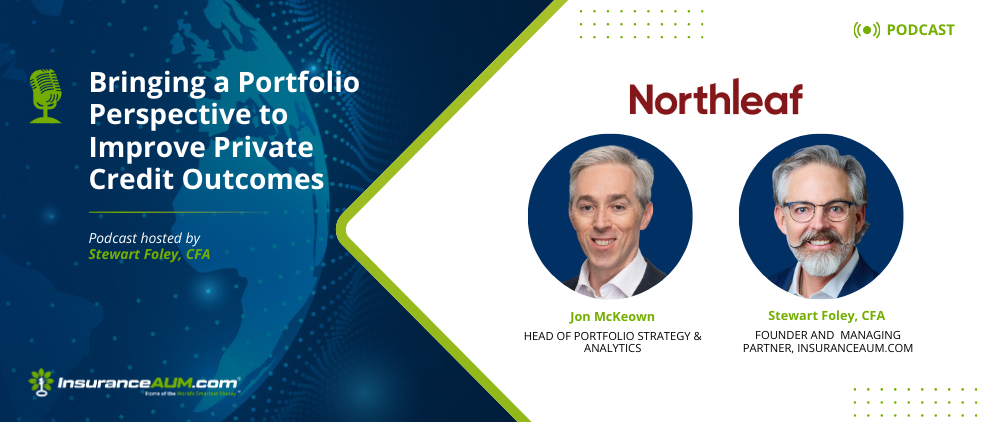
Bringing a Portfolio Perspective to Improve Private Credit Outcomes

Image
08.05 Northleaf_Web


Stewart: Hey, welcome back. It's great to have you. It was really great to see a lot of the people that at our annual meeting in July in Chicago, we had a capacity crowd at that event. There's a video that's gone around that we're really proud of and just want to say thank you so much to our sponsors into the insurance investment community that turns out in force at that event. Just as a reminder, we do have a private credit event, which is a meetings format, which is coming up in Texas - Austin, Texas, on November 5th and 6th this year. It is really geared to private credit specialists within insurance companies and really focused there. It'll be a smaller event than our annual and it's our second year doing it, and you can always count on some live music and a little fun along the way. So hope to see you there. The title of today's podcast, and it's a good one, is Bringing a Portfolio Perspective to Improve Private Credit Outcomes and we're joined today by Jon McKeown, who's at Northleaf Capital Partners. He is the Head of Portfolio Strategy and Analytics. Jon, welcome to the show.

Jon: Thank you, Stewart. It's great to be on the podcast. I appreciate you having me on.

Stewart: Absolutely. Can you give me a little bit of background on what you're doing now? Some info on Northleaf Capital Partners in case folks aren't familiar and a little bit about your path to get to the seat you're in now.

Jon: Northleaf invests in private assets globally and has a consistent focus on the middle market. The firm manages about $30 billion in commitments. The origin of the business was investing in private equity funds on behalf of third-party investors, and over time added both infrastructure and private credit pillars in response to client demand for those strategies. And as far as insurance clients are concerned, private credit, as you might expect, is really the lead asset class. And here we've got two broad investment categories. We have direct corporate lending, which is primarily to sponsor-backed companies. That complements the private equity business, where we've got a host of sponsor relationships going back decades. And then also asset-based specialty finance, which includes things like music royalties and debt factoring. And then finally, we also provide NAV-based loans to private equity funds, which has been a bit of a growth area in recent years.

Stewart: Very cool. What about your journey from uni up to where you are today? I mean, can you talk a little bit about the journey for those who are earlier in their careers, and then a little bit about what the breadth and depth of your current responsibilities are?

Jon: I graduated in, I guess as my children like to say, another century back when career research was looking at leaflets in the library as opposed to combing things online. I did what a lot of my generation in the UK did when they weren't quite clear, and I trained as a Big Four or Big Six accountant as it was back in the day. I did that for three years. I was working in London, and I wanted to learn more about financial services, but I really wanted to travel. So, I took a job with a global bank that afforded me the opportunity to do a range of projects globally for a few years. I learned a little bit about financial services, I learned a lot about different cultures, and got to travel a great deal, which was awesome when you're in your twenties, especially when someone else is paying for the experience. And then after that, I still wasn't clear exactly what I wanted to do, so I did an MBA. After that, I became a strategy consultant, worked in a bunch of different industries, and eventually found my niche with a client that was working in the alternative investing space. I was fortunate to carve out a role there that was based on both corporate strategy but also portfolio strategy and analytics, and that's the field that I've been in for the past 12 years now.

Stewart: So Jon, we always like to ask this question: where did you grow up? And I think this is going to be an interesting answer, so let us have a little bit of that background.

Jon: I grew up in a mid-size town called Keighley, in the county of Yorkshire, in the north of England. It's an industrial town close to the city of Bradford. Both Keighley and Bradford were founded on textile manufacturing, which a hundred years ago meant that Bradford was famous for having a concentration of millionaires, and I believe it had the highest ratio of Rolls-Royces per capita at the time. But by the time I was growing up, these jobs had moved elsewhere, and the region was, it was essentially a little bit economically challenged and depressed. So a little bit different, maybe gave me an appreciation of how shifts in economic forces can affect different places differently. The place was also famous for the Brontë Sisters, which some of your more erudite listeners or people who enjoy books may be familiar with. They grew up in a little village called Haworth, right next to Keighley, and it was these sisters who grew up in the middle of nowhere, but they managed to write a book called Jane Eyre. One of the sisters did, and another sister wrote Wuthering Heights, which is pretty famous in both film and literary form, and also music if you're a fan of Kate Bush.

Stewart: Very cool. Alright, so here's an interesting one. What was your first concert? What's the first concert you ever went to that you paid for it and went on your own?

Jon: For myself, on my own dime, I guess I was 15 or 16, my brother was at university in another city, Birmingham in England, and we were both big fans of the Aussie group INXS. So we got tickets, I went down, got the university experience and was also in the fifth row for Michael Hutchence and the rest of the crew. It set a very high bar for concerts early in my concert-going experience. But it was a great one.

Stewart: I'll say. And I can imagine that seating position left you with some ringing ears for a day or two. That's a fun deal. So you lead the portfolio strategy and analytics team at Northleaf. What does your team do, and why did you create this function within your firm?

Jon: In terms of what we do, maybe I'll start by saying what we don't do. The majority of the investment team's effort is at the deal and transaction level. That's managing the sponsor relationships, originating attractive investment opportunities, and structuring loan solutions that are going to provide strong risk-adjusted returns with good downside protection. So, while the deal team is focused on investing in great companies, it's up to the portfolio team to make sure that these investments are adding up to well-balanced portfolios that deliver on the risk return objectives of each of our mandates. It's kind of hard to be in two places at once—both be down at street level doing the deals, but also take that holistic or broader view looking across the portfolio and making sure it's well balanced. So our team assesses the risk and return, and portfolio fit of each proposed transaction.

We measure and monitor portfolio risk for each mandate. We work with the deal teams to assess any topical risk factors, when there's a pandemic or if there are tariffs. And then we partner with our capital markets team to manage fund liquidity risk and make sure we've got good fund financing facilities in place. So all of that's taken away from the deal team. They focus on the transactions, and we manage all of these portfolio-level considerations. As far as why we did this, it's because we think there's real value there in all these different aspects. Yes, doing great deals is the cornerstone of our business, but putting them together to create great portfolios is what really delivers for investors. And making sure that we're delivering on what we said we were going to in terms of portfolio composition, which is important both for the commingled funds, but especially when you have custom accounts, which we do have with some of our insurance clients.

And I think there's an element of what I would call a little design thinking to this. You can do all the analysis you want, but ultimately, a lot of our business is about decision making, and having a distinct portfolio team focused on those aspects of our business makes sure that we've got a complementary perspective to that, that the deal team is bringing when they've got a new investment. We do partner and collaborate with the deal teams, but it also sets up a healthy tension at times, and we think that that makes for more informed decisions at the investment committee level.

Stewart: Yeah, it's super helpful. So, can you touch base with us about some of the underpinnings of the portfolio analysis that your team does?

Jon: The real core of it is that a few years ago, we developed a measure that we call composite risk and that reflects all of the elements that go into a standard loan that might be made to a company. It gets boiled down to a one to 10 scale, and it reflects a blend of where leverage is set, how much equity is behind us in the capital structure, so what's the loan to value, what cashflow is being generated by the business, and what's the earnings base that we're lending against. And we combine all of this with the proposed economics of the loan that the deal team is recommending to give a measure of relative value or return per unit of risk. I sometimes describe this as being a bit like a price-to-earnings multiple. It's not deterministic; it's not going to say, “Oh, you invest in Deal A, don't invest in Deal B.” But it does give us a consistent quantitative measure, which can kind of guide our discussion and against which we can weigh a whole host of other qualitative factors. So it supports our discussion of the relative value with the investment committee and also allows us to debate as to where we're going to invest the next dollar, or should we be pushing for more pricing or tighter risk terms on a given transaction.

Stewart: It makes total sense. Can you talk a little bit about, I think you touched on this, but how the portfolio strategy and analytics team integrates into decision-making? And you really touched on this, Jon. I mean, you did. The decision-making at the firm is really at the crux of your success, right? Walk us through that process.

Jon: I'd say there are probably three key stages. The first is origination. With so many hours in the day and so many opportunities to focus on, our analysis helps guide the deal team. So, the portfolio, we give them quite explicit guidance as to what each mandate is looking for, and across the platform, what it adds up to in terms of capacity for different types of transactions. Which part of the capital structure are we favoring or looking to invest in? Where are we currently with regard to exposure to different industries or geographies? Are there certain sub-sectors where we're full up and we have enough exposure? Are there other areas where we're looking to increase exposure across our funds? So that really helps guide the origination efforts and make sure that they're efficient and focused on the right areas for the portfolio. Then once it goes to underwriting, I think I touched on this before, it's really about that independent assessment of risk and relative value, which helps the investment committee ultimately make the decisions for the fund as to where to invest, which things are going to go forward through the pipeline, which are not.

And then post transaction, as a lot of private credit is monitoring the performance, staying close to the borrowers and the portfolio. So the deal team does all of that at the asset level, closely assessing the performance of each of our loans. We take all the financial data that's being ingested into our portfolio management systems, and we aggregate the overall trends we're seeing across the platform, and what we are seeing by mandate. That, in turn, again brings us back to origination. Where do we want to be more risk-off? Where are we seeing good relative value or strong performance? And on a risk-adjusted basis, we're more inclined to invest the next dollar. So, it really helps bring together both the deal team, as I said before, kind of the street-level view, with the broader view that the portfolio team has looking across all of the investments that we're doing across the full portfolio.

Stewart: It's interesting. I think at the end of the day, insurance companies are, I think, you make it in basis points and you lose it in percentage points, right? So the downside is always on the mind of an insurance investor. Why is having a portfolio strategy and analytics function important for the client?

Jon: I think you touched on it. It is that tension between, we have the measure that I touched on before of relative value to see where we see stronger relative value. And that's where, for example, I mentioned at the outset, asset-based specialty finance. We do assess that as offering a return premium, and we do seek to prove that out empirically. But then, as you say, the downside is in percentage points, and that's where having an independent group that A) has the purview and the perspective across the portfolio, and B) a little bit of remove and discipline from the individual deals will be the ones who will say no more. We've already got two or three investments in a certain sub-sector, so we're not going to invest another dollar.

So it's helpful to separate that out and have the discipline because ultimately that helps cap the downside. None of us have a crystal ball, but if you do look back into the past and you look at any given recession, you'll see normally losses will be concentrated on a handful of different sub-sectors, or you also see variations by geography. So, if we went back to the GFC, for instance, you could look west to California and see there wasn't much in the way of defaults in that part of the country, but there was a lot more in the Midwest. We'll go to the next level in looking at geography, for example, and not just look at our exposure to the United States, but we drill down with the mid-market businesses that we lend to and we look at what is their footprint, what's their revenue exposure, and we make sure we're not overly exposed to any one region. You get just as much variation in the United States as you do in say western Europe, in terms of outcomes in any given cycle.

Stewart: Yeah, and it's interesting. I mean, you have a front row seat into some markets that not everyone plays in, which I think is part of what makes you interesting, among other things, obviously. But what are some of the trends that Northleaf and the portfolio management team have seen and that you were most focused on in the last year or two? And I guess I'd add to that question, opportunities, as well as, are there trends that are making you cautious?

Jon: Sure. I mean a large part of what the repeated analysis that we do, and there is benefit in doing the same analysis quarter after quarter, so you can sort of calibrate and assess things. There's a reasonable proportion of that that's focused on the classic two areas of geography and sector. If we take geography, first of all, over the last 18 months, we've been steadily increasing our exposure to Western Europe. We do think it's helpful to be able to look across North America, look across western Europe, and see what's going on with relative value and critically what's going on with company performance. What we've seen is a relative value advantage in Europe. If you went back more than three years, before the invasion of Ukraine, we were seeing very similar return-per-unit-of-risk metrics between Europe and North America.

Once the invasion of Ukraine did happen, there was a widening, and you were seeing better objective relative value, obviously reflecting the circumstances on the ground in Europe, with wider spreads for every unit of risk. But what we saw was those persisted, even after the situation stabilized and we had a more positive view on Europe, that return premium has persisted and we think there are other factors at play, structural factors to do with private credit, the flow of dollars, in particular into North America, and the capacity to deploy in Europe maybe being a little bit tighter historically. So, on a risk-adjusted basis, we've definitely viewed Europe favorably. And I think over the course of the last six to 12 months, you've seen a lot more about that in the press, but there continues to be a bit of a return advantage from our perspective.

And then in terms of sector, I think this is pretty well publicized by others, but the areas where we've been less constructive have been healthcare and consumer, given the impact of wage inflation and concerns about whether the economy is to cycle, that there could be more impact there. And we tended to favor increases in financials and business services. And in our case, in particular, because we do have the niche asset-based lending that I referred to earlier, I think at any time it provides a diversification benefit. There's a very low correlation to what's going on in the broader economy, but in particular, at this point, where there's some concern about the end of the economic cycle, are we going to need to be reducing rates with lower payrolls, less job creation. We continue to view asset-based lending as a very positive area for private credit portfolios.

Stewart: And earlier, you mentioned NAV lending. Can you, just for my own benefit, with kind of the pretty good size crayons, help me understand NAV lending and talk about how you see that opportunity?

Jon: NAV lending is a product that has been around for a number of years. It involves, rather than making a loan to an individual company that might be in a private equity portfolio, making a senior loan to the fund itself, which is supported by the equity interest in multiple underlying portfolio companies. So, in one sense, you could think of it as being a substitute for junior debt. It came to the fore as interest rates increased with inflation and junior debt, which might previously be priced at a risk-free rate of essentially zero plus something of the order of 7% or 8%. That now becomes pretty pricey for the private equity companies when interest rates are running at 4% or 5%, it's costing almost as much as equity capital. I think what that made apparent to people is the benefits of fund financing, but we believe those benefits are there through the cycle.

What it effectively does is it takes the portfolio benefit that the private equity company has, and it realizes that in terms of a lower cost of financing by lending across a portfolio of equity interest rather than lending individually in the form of junior capital company by company. It effectively allows the private equity companies to borrow at a very low loan-to-value at the fund level and to secure a cost of financing, which is more like first lien or unitranche as opposed to junior or mezz debt. We've run plenty of analysis, and we're comfortable with the structure. It does have some structural complexity to it, but it ultimately allows the private equity sponsors to borrow at a lower cost of financing while allowing for a stronger collateral package for the lenders than we would be receiving with a junior loan on a company-by-company basis.

Stewart: I have what very well may be a dumb question. So, this is somewhat, I've somewhat cornered the market on this show for dumb questions. So when you're doing NAV lending, is it possible that there is leverage at the company level as well? And is that something that you look at or consider, sort of what I would refer to as the total leverage? Does that come into play in your analysis?

Jon: Absolutely, and that's the key is you're effectively trading being deeper in the capital structure. So it's not first-dollar risk. Once you take into account the leverage at the company level, you're trading that for the portfolio diversification benefit of lending against 10 or 12 companies in a given portfolio rather than just one company. And also the structural protections that go along with the loan document, which compel the borrower to pay down the loan as the portfolio starts to reduce in size or if the loan-to-value increases above a given level.

Stewart: Super helpful, thank you. I mean, I appreciate the education. So this is the part of the show where I ask you if you could dust off your crystal ball and look forward. So are there other considerations that are top of mind as you think more intermediate to long-term in these markets?

Jon: Yeah, the first one that we already touched on is the increased cost of money. We went through a period from the GFC to 2020 where money was extremely cheap, and it was our view, as we went into the inflationary period, that it was probably going to settle at a higher level than it had in the past, the risk-free rate. I think that's what most commentators would now expect going forward. And obviously this has significant implications for the private equity industry, in terms of how they are going to create value, what is going to be generated from financing, what's going to be generated from multiple increases, and what is going to be generated from value creation at the asset level with a lot more need for asset creation, organic value creation at the company level. Generally speaking, we think that favors the middle market, where there are more opportunities to improve operations and to scale businesses and generate efficiencies, and also where there's arguably more exit options for the private equity sponsors. But no doubt it's going to impact the middle market value creation model as well. And that's why it's very important to not only select strong companies, but also strong sponsors that have a history of value creation and not just financial engineering to generate returns for their investors.

Stewart: Yeah, that's really helpful. So that's kind of the asset class-specific stuff. I've got a couple of fun ones for you on the way out. So the first one really tries to address the culture at Northleaf. What characteristics do you look for when you are adding members to your team? Not the hard skills, not the pedigree, but are there characteristics that you have found over your career that are favorable for this industry and for Northleaf?

Jon: Yeah, the two things that jump to mind, and they are the kind of things that other people will talk about, but I think for very good reason. The first is being intellectually curious. As I think you alluded to upfront, having a portfolio strategy team is not necessarily in every investment platform and it involves being inquisitive about what is happening in the portfolio and also being inquisitive about what's happening in the broader world and relating Northleaf’s experiences to what we're seeing in market data and elsewhere and also in analogs in the public markets. So I think it really favors someone who is capable of finding out the answers to questions, and ultimately, as they get more senior, thinking about what are the right questions to be asking, what are they curious about. And ultimately, that will generate interesting insights for our investment committee and our investors to consider.

And then the second thing is it is being collaborative. Like many organizations, Northleaf is, and as it's gotten bigger, there's more specialization. But to really be effective, and we mentioned this earlier with the organization design, it's not just about what analysis you do and what insights it's about, how that comes to bear, how you partner with other teams, and ultimately how you communicate those insights. So even though it's a pretty analytical team, we definitely need people who can interface effectively with others and, as they grow as professionals, are able to communicate insights clearly and concisely to decision makers.

Stewart: Good deal. That's awesome. Last one, you can have dinner with up to three guests, one, two, or three. Who would you most like to have lunch with, alive or dead, Jon McKeown?

Jon: The first one I'd call out would be a lady called Zadie Smith. She's a similar vintage to myself. She's British, but like me, she spent a lot of time in North America. She's an author. Her big book was White Teeth, but she's done many others since, and she's also been a successful essayist. I find that she's a really good observer of people in the human condition. She really gets into the heads of the characters that she creates, and I also heard her on a podcast recently, which is probably why I'm thinking of her, and she was both really insightful about people and she also made me laugh. So that would be the first one. The second one, which is also the recency effect, would be an artist called Beck. Imagine you're probably familiar with him.

Stewart: Yes.

Jon: Going back to Odelay and Loser, I saw him in concert a couple of weeks ago with an ATP string orchestra. I mean, I love music, but I have no musical talent, but he's so creative in his field. I think it would be really interesting to hear how he thinks, not just about music, but about the world in general. Then the last one I'll call out is probably because I love movies. It would be my favorite movie director. He's a gentleman called Peter Weir. Some of the older films he did that I loved were historical political dramas, like The Year of Living Dangerously, and a war movie, Gallipoli. And then more recently, some bigger films that people have probably heard of are Dead Poets Society, Witness, and The Truman Show. So he's a bit like Zadie Smith. He's another interesting observer of the human condition. Plus, he's Australian. I lived there for a year. I really like the Aussie sensibility and sense of humor, so I think he would be good to have along as well.

Stewart: I love it. We've really enjoyed having you on, Jon. Thanks so much for taking the time.

Jon: Thank you very much, Stewart. Appreciate it.

Stewart: We've been joined today by Jon McKeown, Head of Portfolio Strategy and Analytics at Northleaf Capital Partners. If you have, and I say this every time, but if you have ideas for podcasts, please shoot me a note at Stewart@insuranceaum.com, and here's why it matters. Our entire agenda at our July flagship event was created by Insurance CIOs, and we want to do podcasts that are consistent with what you want to hear. So please take a minute and send me a note. I'd sure appreciate it. We will act on it, I promise. Also, please rate us like us and review us on Apple Podcast, Spotify, or on our brand new YouTube channel at Insurance AUM Community. My name's Stewart Foley. We are the home of the world's smartest money at InsuranceAUM.com.
 

Share this post

Sign Up Now for Full Access to Articles and Podcasts!

Unlock full access to our vast content library by registering as an institutional investor

Register

Contacts


Northleaf

Northleaf is a global private markets investment firm focused on mid-market companies and assets. With more than $30 billion in capital commitments to date, Northleaf has a successful long-term track record as a principal investor in private equity, private credit and infrastructure globally. 

Northleaf’s global leadership team is supported by more than 275 professionals in ten offices in North America, Europe, Asia and Australia. Headquartered in Toronto, Northleaf builds on the Canadian tradition of long-term investing in private markets. Northleaf’s success has been driven by its enduring partnerships and the delivery of consistent long-term investment returns. 

William Allis 
Managing Director, Insurance Solutions  
william.allis@northleafcapital.com   
+1 646 512 9600

299 Park Avenue, 41st Floor  
New York, NY 10171


View the contributor page

Sign Up Now for Full Access to Articles and Podcasts!

Unlock full access to our vast content library by registering as an institutional investor .

Create an account

Already have an account ? Sign in

Ѐ Ё Ђ Ѓ Є Ѕ І Ї Ј Љ Њ Ћ Ќ Ѝ Ў Џ А Б В Г Д Е Ж З И Й К Л М Н О П Р С ΄ ΅ Ά · Έ Ή Ί Ό Ύ Ώ ΐ Α Β Γ Δ Ε Ζ Η Θ Ι Κ Λ Μ Ν Ξ Ο Π Ρ Ё Ђ Ѓ Є Ѕ І Ї Ј Љ Њ Ћ Ќ Ў Џ А Б В Г Д Е Ж З И Й К Л М Н О П Р С Т У Ф Х Ц Ч Ш Ā ā Ă ă Ą ą Ć ć Ĉ ĉ Ċ ċ Č č Ď ď Đ đ Ē ē Ĕ ĕ Ė fi fl œ æ ß