

We're currently experiencing email delivery delays. For urgent matters, please contact us directly at lindsay@insuranceaum.com.

Pioneer Investments -

Credit Contagion? Not So Fast.

PioneerFeatured

Paresh Upadhyaya SVP, Director Fixed Income and Currency Strategies


Turmoil in a few regional banks and private credit players does not suggest contagion, or even a severe credit contraction.

Executive Summary

  • The anomalous credit issues that have surfaced in the US over the past few weeks are not indicative of a wider systemic issue.
  • The recent sell-off in the US banking sector seems overdone, and we see a disconnect between market fears and credit performance.
  • Pioneer Investments equity strategies are focused on the mega-cap and top-tier regional banks, and the recent sell-off may be an attractive buying opportunity. 

The demise of car parts manufacturer First Brands and subprime auto lender Tricolor, along with loan troubles at Zions Bank, has raised broader concerns about the US banking industry and the possibility of a credit contagion. While broader equity markets have so far been unfazed, the S&P Regional Banks Select Industry Index has declined 7% from its peak in September on the back of these concerns. 

Some investors are wondering: does the explosive growth of private sector credit, which was used to fund First Brands expansion, signal potential problems in the US financial system. Do we need to be worried? 

We believe the answer is clear. There is no imminent contagion, and we are not on the cusp of a wider systemic issue, in our view. 

Four thoughts inform our opinion: 

  1. Private credit is a fraction of overall corporate lending:  Private sector credit—loosely defined as debt financing provided to by non-bank entities, such as lending institutions, asset managers and private equity firms—has grown spectacularly over the last 15 years. This was largely a byproduct of investors’ desire for more income in a low-yield environment, coupled with the added regulations (i.e., stricter capital requirements) adopted by the banking industry in the wake of the Global Financial Crisis of 2008/09. Despite its impressive growth, private sector credit is still estimated to be just a fraction of all corporate borrowing. Thus, we think it’s highly unlikely that any turmoil in the private credit market is a threat to stable and well-regulated US banks.
  2. Easing, Not Tightening: It is true that the economic outlook in the US is cloudy, and unemployment has been trending higher, according the Bureau of Economic Analysis. In turn, the US central bank (the Federal Reserve, or Fed) cut the Fed funds rate by 25 basis points in September, and more rate cuts are likely ahead. Thus, while some banks may be raising credit standards and demanding more collateral for loans, the Fed is busy creating a more accommodative environment for future borrowers. It’s unlikely that a severe credit crunch is underway at the start of a new rate-cut cycle. In addition, the Fed’s October 16 H.8 report, which tracks deposits, residential and commercial real estate loans, and consumer loans, does not show any credit tightening. In fact, deposits have increased, and we believe it is a leading indicator of credit growth. If this trend reverses and we see deposits turning negative in the weeks ahead, we might be more concerned.
  3. The Fed (and Friends) Have Your Back: Monetary policy is one thing. But beyond that, it’s important to remember that the Federal Reserve, The Federal Deposit Insurance Corporation and the Treasury Department have the tools (and the willingness to deploy them) to combat any threat of contagion. Remember, just a few short years ago, a few US banks were caught with too much Treasury exposure at a time when interest rates were rising rapidly. Depositors lost confidence and triggered old fashioned bank runs. But there was no contagion. Bank acquisitions/rescues were orchestrated, and a new lending facility was created—the Bank Term Funding Program—to ensure that any troubled bank could meet withdrawal demands. We can debate if that was a good idea or not, but it’s clear that the US Treasury Department was keen to backstop the financial system. The Fed’s October 16 H.4.1 report details the Fed’s lending and will be useful to see if there are any additional stress in financial markets. Within that report, it would likely come up via the discount window. We will be monitoring to see if institutions are tapping the discount window.
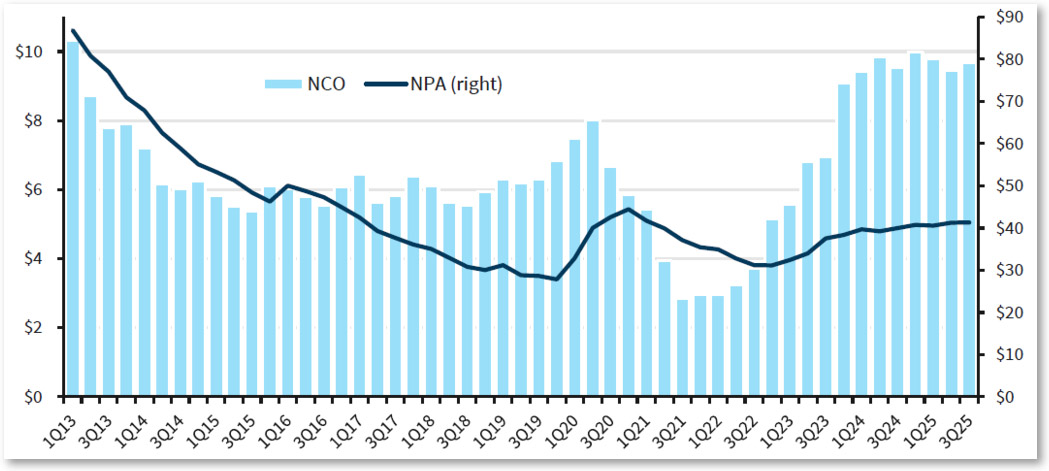
  4. Asset quality at banks remains high: Non-performing assets (NPAs) are precursors to net charge-offs (NCOs) and therefore drive the need to increase loss reserves by provisioning for credit losses (an expense). Hence, NPAs become detractors to earnings. NPAs and NCOs have both been flat for the last several quarters, and we expect them to remain in these ranges in 2026. Meanwhile, revenues have been growing at a stronger pace and should continue to do so. This should also drive increasingly better bank earnings and returns on equity. For the largest US banks, both the mega caps and top large-cap regional banks that Pioneer Investments own, all recently reported improved NCO ratios and declining NPAs. Important areas such as consumer credit were flat-to-down (i.e., improved), contradicting fears of consumer stress, and commercial real estate also showed signs of bottoming with declining NPAs. The upshot is a significant disconnect between market fears and actual credit performance.
     
Chart 1: Non-performing Assets and Net Charge-offs ($ in billions)
Barclays Large-Cap Bank Composite, 1Q13-3Q25
Image
Non-performing Assets and Net Charge-offs ($ in billions) Barclays Large-Cap Bank Composite, 1Q13-3Q25

Barclays Large-Cap Bank composite excludes NTRS and FCNCA in all period given they have yet to report 3Q25 results.
Source: Barclays Research and Company Reports as of October 21, 2025.
 

Pioneer Investments Portfolio Strategy

The Pioneer Investments equity strategies’ largest US bank positions are the top mega cap banks, followed by a handful of top-ten banks. The recent market overreaction to what we believe is a one-off credit/fraud issue looks like a buying opportunity to us. Business and financial momentum is becoming clearer and more obvious based on the yield curve, continued low credit losses, increasingly robust capital markets activity, a more benign regulatory regime and, in our opinion, industry leading technology/AI execution. We believe all of this suggests the market may be underestimating. Moreover, valuations appear attractive and capital returns are currently high.

The Verdict: A Few Bad Apples, Not a Systemic Issue

We have strong conviction that the anomalous credit issues that have surfaced in the US over the past few weeks are not the beginning a wave of credit-down-cycle problems, and we find the reaction to be dubious and far overdone. Both mega-cap and top regional banks demonstrated that recent credit concerns have had minimal operational impact, with institutions showing stable-to-improving credit metrics and adequate capital buffers to absorb any residual normalization in credit costs over the next two to three quarters. 

Read More From Pioneer Investments


Important information

Unless otherwise stated, all information contained in this document is from Pioneer Investments, a Victory Capital Investment Franchise. The views expressed regarding market and economic trends are those of the author and not necessarily Pioneer Investments and are subject to change at any time based on market and other conditions, and there can be no assurance that countries, markets or sectors will perform as expected. These views should not be relied upon as investment advice, a security recommendation, or as an indication of trading for any Pioneer Investments product or service. This material does not constitute an offer or solicitation to buy or sell any security, fund units or services. Investment involves risks, including market, political, liquidity and currency risks. Past performance is not indicative of future results.

©2025 Victory Capital Management Inc.

20251023-4927395

Share this post

Sign Up Now for Full Access to Articles and Podcasts!

Unlock full access to our vast content library by registering as an institutional investor

Register

Contacts


Pioneer Investments

Pioneer Investments manages $128 billion in assets and has a long-standing history of innovation with deep expertise managing fixed income portfolios and creating customized solutions within the more opportunistic areas of the securitized market.

Pioneer Investments’ culture of innovation, in the securitized market, originated at Smith Breeden, where its founders developed early option-adjusted spread modeling techniques for MBS valuation. The innovative approach continues under Victory Capital, which manages over $8.4 billion for insurance companies. We are focused on delivering competitive risk-adjusted returns, while considering the accounting, regulatory, and capital management needs of our insurance clients to create long-term partnerships.  We understand the unique needs of insurers, and we provide customized and efficient risk-based capital solutions that align with insurers' risk tolerances and investment objectives.

Source: Pioneer Investments, a Victory Capital Investment Franchise, as of September 30, 2025
 

Jay Alexander, CFA, CAIA
Managing Director, Institutional Markets
jalexander@vcm.com
+1 (612) 965-5426
 
Emma White
Director, Institutional Markets
ewhite@vcm.com
+1 (617) 422-4569

Marko Komarynsky
Director, Institutional Markets
mkomarynsky@vcm.com
+1 (210) 697-3613

View the contributor page

Sign Up Now for Full Access to Articles and Podcasts!

Unlock full access to our vast content library by registering as an institutional investor .

Create an account

Already have an account ? Sign in

Ѐ Ё Ђ Ѓ Є Ѕ І Ї Ј Љ Њ Ћ Ќ Ѝ Ў Џ А Б В Г Д Е Ж З И Й К Л М Н О П Р С ΄ ΅ Ά · Έ Ή Ί Ό Ύ Ώ ΐ Α Β Γ Δ Ε Ζ Η Θ Ι Κ Λ Μ Ν Ξ Ο Π Ρ Ё Ђ Ѓ Є Ѕ І Ї Ј Љ Њ Ћ Ќ Ў Џ А Б В Г Д Е Ж З И Й К Л М Н О П Р С Т У Ф Х Ц Ч Ш Ā ā Ă ă Ą ą Ć ć Ĉ ĉ Ċ ċ Č č Ď ď Đ đ Ē ē Ĕ ĕ Ė fi fl œ æ ß