

We're currently experiencing email delivery delays. For urgent matters, please contact us directly at lindsay@insuranceaum.com.

AEW Capital Management -

Essential Housing Research Perspective

AEWFeatured

Michael Acton, CFA® Managing Director, Head of Research & Strategy, North America 


The 90+ days stretching from April 2nd Liberation Day through the July 4th signing of the One Big Beautiful Bill (OBBB) represents one of the most consequential periods of federal government policy change in many years. When taken together, these policy changes are, at best, mixed and in some ways negative for both future essential housing development and the financial wellbeing of essential housing renters.

With respect to supply, various OBBB provisions are designed to encourage more investment in affordable housing through expansion of various aspects of low-income housing tax credits (LIHTC), more predictable funding of new market tax credits (NMTC), and enhancements to the opportunity zone programs introduced in the 2017 precursor to the OBBB. The OBBB also restores 100% bonus depreciation for furniture, fixtures, equipment, and landscaping in LIHTC and other projects.
 

Table 1
OBBB Provisions Likely Impacting Affordable Housing Development
  • Permanent 12% increase in each state’s annual allocation of 9% LIHTCs.
  • Lower bond financing threshold for 4% credits, with the “50% test” for private activity bond financing permanently reduced to 25%.
  • Expanded GSE investment cap, Fannie Mae and Freddie Mac can now each invest up to $2 billion annually in LIHTC properties (up from $1 billion), totaling $4 billion per year.
  • Permanent extension of the New Markets Tax Credit (NMTC), with $5 billion annual allocation authority.
  • Permanent extension of the OZ Program, with rolling 10-year new OZ census tracts.
  • Census tracts must now meet tighter definitions of “low-income community,” with poverty rate ≥ 20% and median household income ≤ 125% of statewide or metro median income.
  • Capital gains invested in Qualified Opportunity Funds (QOFs) can now be deferred for 5 years from the investment date with investors receiving 10% basis step-up after 5 years and 30% step-up for investments in rural OZs.

Source: Novogradac
 

At the same time, however, significant changes to existing tariff rates on products and countries introduce potentially higher and more variable future costs for a wide range of building materials, appliances, furniture and fixtures, making the overall impact on all future development, including affordable housing, less clear.

In terms of demand and renter household financial wellbeing, particularly for below median income households, the impacts of tariffs and the OBBB are mixed at best and negative in some specific dimensions. Most significantly, tariffs are a tax on consumption and the current average effective tariff rate of nearly 20% represents one of the largest consumption tax increases in U.S. history. The Budget Lab at Yale estimates this new tariff rate will increase the average cost of goods currently purchased by U.S. households by approximately $2,400 per year, an amount that many households, particularly below median income households simply cannot absorb into existing budgets. Historically, federal tax policy generally eschewed consumption-based tax schemes as regressive, disproportionately impacting lower income households, particularly with respect to non-discretionary items such as food and clothing.

With respect to the OBBB, most households will see modest tax relief, primarily through an increase of $750 in the standard deduction for single filers ($1,500 for married filing jointly) and the increase in the child tax credit form $2,000 to $2,200. Additionally, some households will benefit from limited tax relief for tipped income and overtime pay, though currently these benefits are not expected to be realized until households file for and receive tax rebates next year. Importantly, the newly created tax relief for tip income, overtime and the new special deduction for seniors all expire at the end of 2028 unless extended by the next administration. Overall, the Tax Policy Center estimates that 70% of American households will experience no additional tax cut benefit after the end of the 2028 tax year. For the essential housing renter, the Tax Policy Center also projects limited after-tax income gains for the median income (and below) household, approximately $1,000 for households earning between $50,000 and $75,000. Overall, any after tax-income gains for below median income households is likely to be more than offset by higher costs of goods related to new tariffs.

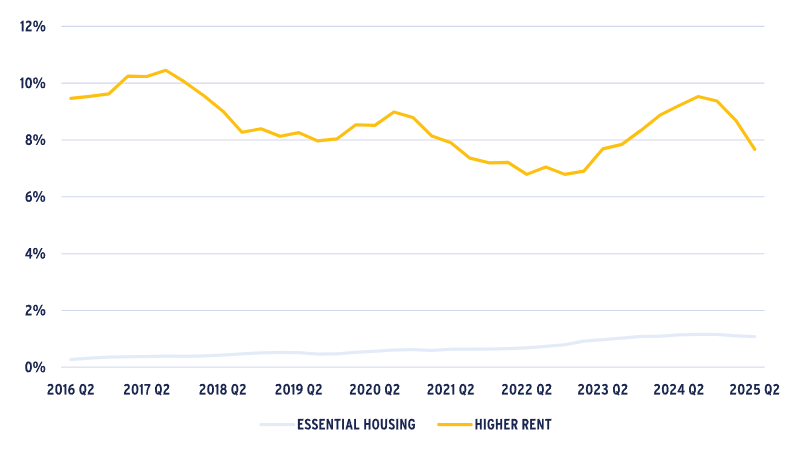
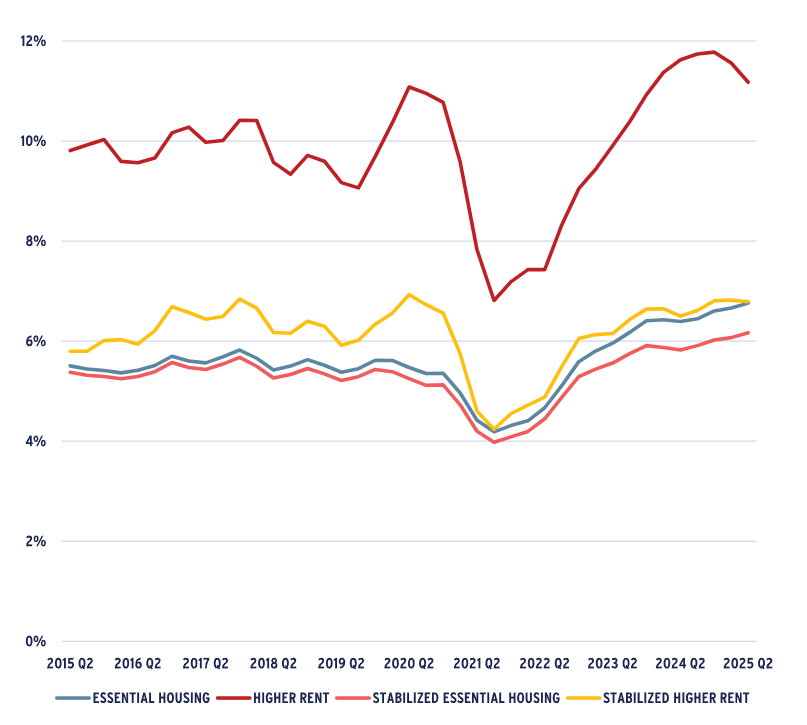
Future tariffs and OBBB impacts aside, assessment of the status and direction of the current U.S. apartment market remains complicated. Data from CBRE-EA continues to show steady improvement in the overall vacancy rate, but CBRE-EA includes very few non-stabilized properties (i.e., properties still in lease up). Using data from CoStar, the total vacancy rate for higher rent units modestly improved over the first half of 2025 but remains high by historical standards at slightly more than 11%. When the higher rent segment is adjusted to exclude properties that are not yet stabilized, the vacancy profile reverts to levels much closer to the typical vacancy of essential units. For essential units, the differences between the vacancy rate for stabilized properties and properties that are not yet stabilized are quite small, largely because there are typically much fewer new units delivered within the essential segment of the market, despite it representing a much larger share of total stock. To this point, Figure 1 illustrates the year-over-year growth in rental stock over the past decade. While the new supply (growth in stock) is slowing in the higher rent segment, it remains multiples above the long observed lower growth rate of the essential stock.
 

Figure 1
Year-Over-Year Growth in Rental Stock
Image
Graph showing YEAR-OVER-YEAR GROWTH IN RENTAL STOCK

Source: CoStar, AEW Research
 

Figure 2
Apartment Vacancy Rate
Image
Graph showing decrease in apartment vacancy rate in 2021 across various sectors

Source: CoStar, AEW Research
 

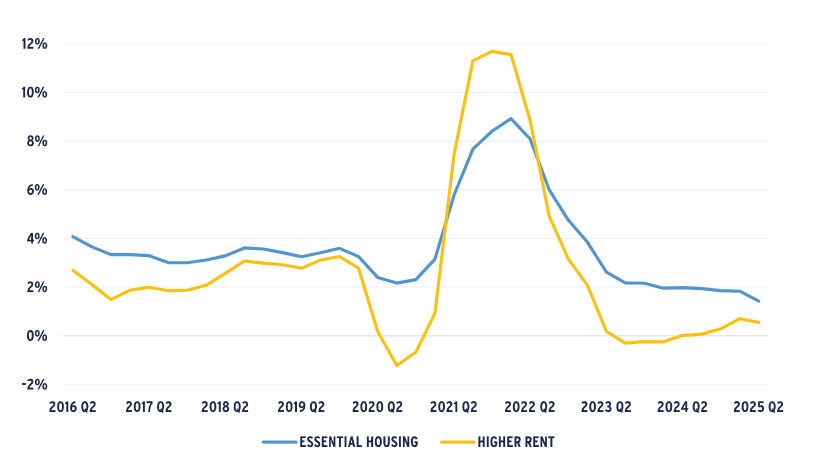
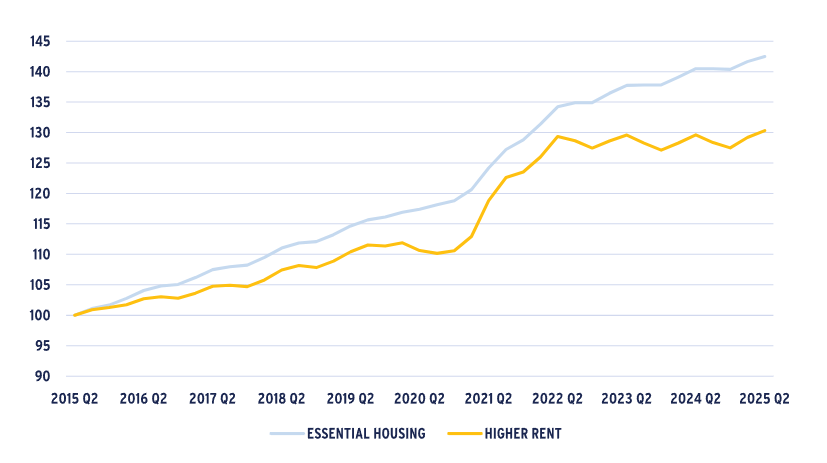
Reflecting the differences in overall vacancy, the slowdown in effective rent growth within the higher rent segment has been more pronounced than in the essential segment. On a year-over-year basis, rent growth in the higher rent segment moved into positive territory over the first half of this year while the essential segment has seen a slight deceleration from the stable 2% range of the past two years. When we examine the compounded impacts of the differences in rent growth we find, on average, 11% higher rent gain in essential housing over the past ten years, slightly more than one hundred basis points per year (4.8% CAGR vs 3.8%).
 

Figure 3
Year-Over-Year Rent Growth
Image
Graph showing a spike in rent growth in 2021 and 2022

Source: CoStar, AEW Research
 

Figure 4
Average Effective Rent Index, 2015 Q1 = 100
Image
Graph showing steady increase in effective rent index over the last decade

Source: CoStar, AEW Research
 

Figure 5
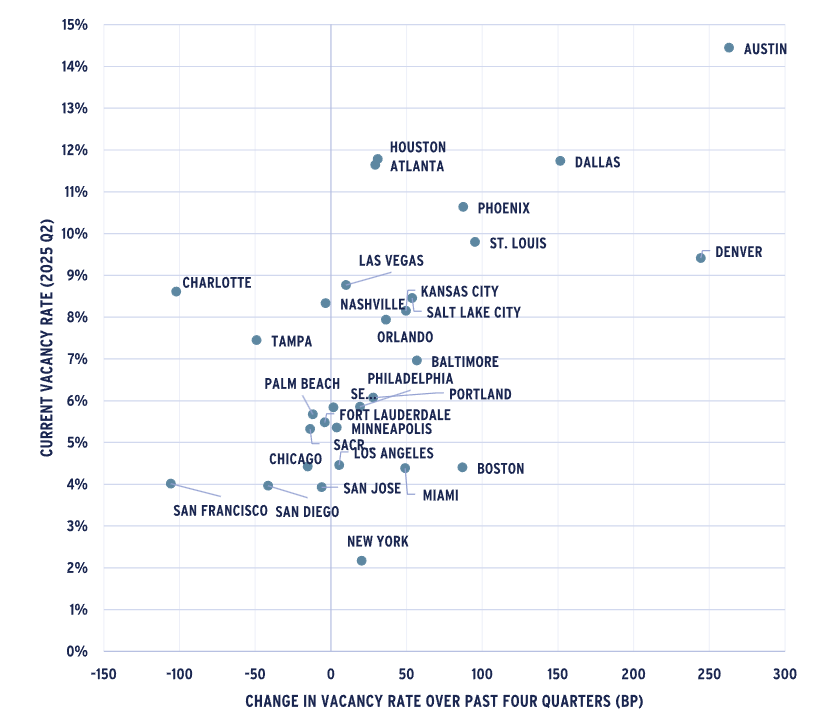
Current Essential Housing Vacancy Rate and Change Over Past Four Quarters
Image
Scatter plot of vacancy rate in various U.S. cities

Source: CoStar, AEW Research, 2025 Q2
 

Figure 6
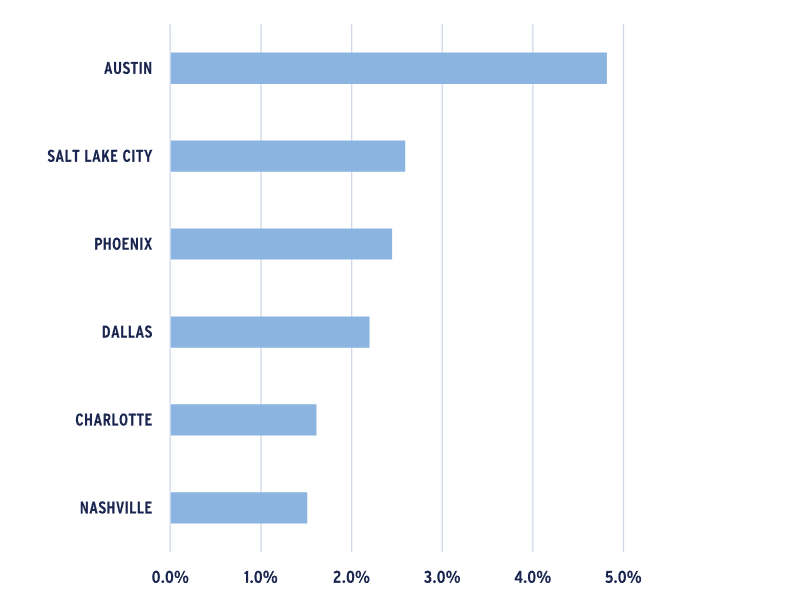
Year-Over-Year Growth in Essential Housing Inventory
Image
Bar chart showing growth in Austin, Salt Lake City, Phoenix, Dallas, Charlotte, Nashville

Source: CoStar, AEW Research 2025Q2


Read More From AEW Capital Management


For more information, please contact:
MICHAEL ACTON, CFA®

Managing Director, Head of Research & Strategy, North America

michael.acton@aew.com

+1.617.261.9577

JAY STRUZZIERY, CFA®
Head of Investor Relations
jay.struzziery@aew.com
+1.617.261.9326

This material is intended for information purposes only and does not constitute investment advice or a recommendation. The information and opinions contained in the material have been compiled or arrived at based upon information obtained from sources believed to be reliable, but we do not guarantee its accuracy, completeness or fairness. Opinions expressed reflect prevailing market conditions and are subject to change. Neither this material, nor any of its contents, may be used for any purpose without the consent and knowledge of AEW. There is no assurance that any prediction, projection or forecast will be realized.


Share this post

Sign Up Now for Full Access to Articles and Podcasts!

Unlock full access to our vast content library by registering as an institutional investor

Register

Contacts


AEW Capital Management

For over 40 years, AEW Capital Management, L.P. (AEW) has provided real estate investment management services to investors worldwide. As one of the world’s largest real estate investment advisors¹, AEW and its affiliates manage $87.0 billion in private real estate equity, debt and listed securities across North America, Europe and Asia (as of June 30, 2025). Grounded in research and experienced in the complexities of the real estate and capital markets, AEW actively manages portfolios in both the public and private property markets and across the risk/return spectrum. AEW and its affiliates have offices in Boston, Los Angeles, Denver, London, Paris, Hong Kong, Seoul, Singapore, Sydney and Tokyo, as well as additional offices in eight European cities. For more information, please visit www.aew.com.
 

¹Source: “2025 IREI.Q Real Estate Managers Guide”. The Guide, published annually by Institutional Real Estate, Inc., ranks real estate managers based on the gross value of real estate AUM ($m) as of December 31, 2024. As of June 30, 2025. AEW includes (i) AEW Capital Management, L.P. and its subsidiaries and (ii) affiliated company AEW Europe and its subsidiaries. AEW Europe and AEW Capital Management, L.P. are commonly owned by Natixis Investment Managers and operate independently from each other. Total AEW AUM of $87.0 billion includes $42.2 billion in assets managed by AEW Europe and its affiliates, $4.4 billion in regulatory assets under management of AEW Capital Management, L.P., and $40.4 billion in assets for which AEW Capital Management, L.P. and its affiliates provide (i) investment management services to a fund or other vehicle that is not primarily investing in securities (e.g., real estate), (ii) non-discretionary investment advisory services (e.g., model portfolios) or (iii) fund management services that do not include providing investment advice.

Chad Nettleship
Insurance, Investor Relations
chad.nettleship@aew.com

617.261.9485


2 Seaport Lane
Boston, MA 02210


View the contributor page

Image
AEW.png

Sign Up Now for Full Access to Articles and Podcasts!

Unlock full access to our vast content library by registering as an institutional investor .

Create an account

Already have an account ? Sign in

Ѐ Ё Ђ Ѓ Є Ѕ І Ї Ј Љ Њ Ћ Ќ Ѝ Ў Џ А Б В Г Д Е Ж З И Й К Л М Н О П Р С ΄ ΅ Ά · Έ Ή Ί Ό Ύ Ώ ΐ Α Β Γ Δ Ε Ζ Η Θ Ι Κ Λ Μ Ν Ξ Ο Π Ρ Ё Ђ Ѓ Є Ѕ І Ї Ј Љ Њ Ћ Ќ Ў Џ А Б В Г Д Е Ж З И Й К Л М Н О П Р С Т У Ф Х Ц Ч Ш Ā ā Ă ă Ą ą Ć ć Ĉ ĉ Ċ ċ Č č Ď ď Đ đ Ē ē Ĕ ĕ Ė fi fl œ æ ß