

We're currently experiencing email delivery delays. For urgent matters, please contact us directly at lindsay@insuranceaum.com.

Morgan Stanley Investment Management -

Evolution of Direct Lending

InsightFeatured

Key takeaways include:

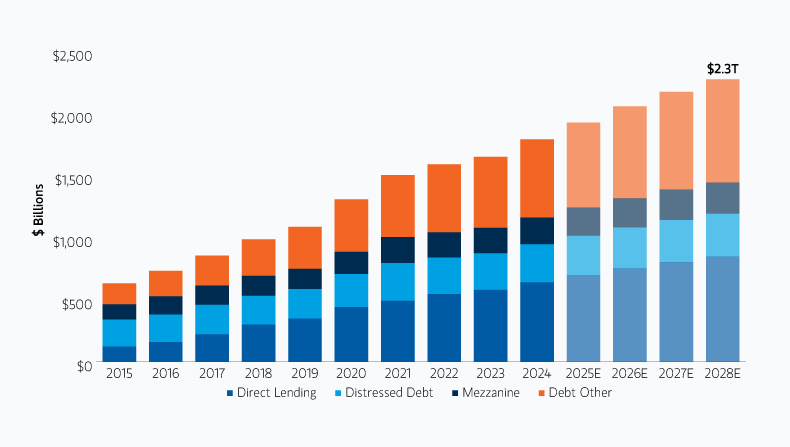
  • Direct Lending is by far the single largest strategy within private credit today, having grown from 9% to 36% of total assets under management over the last 15 years.1
  • This growth has been fueled by borrower need and investor demand. Middle market companies have flocked to direct lenders as the number of banks has fallen by 53%,2 and investors have seen Sharpe ratios enhanced by allocating more of their portfolios to Direct Lending.
  • Direct Lending’s main target market, the middle market borrower, has demonstrated lower default rates and loss ratios when compared to the large corporate market for syndicated loans, based on 25 years of historic data.3

Direct Lending is a type of Private Credit strategy that makes direct, illiquid loans to middle market companies outside of the traditional banking system. Direct Lending usually refers to first lien loans as well as unitranche loans that combine different debt classes or liens into a single loan.  
 

DISPLAY 1 | Projected and historic growth in private assets
Image
insight_evolution-of-direct-lending_display-1

Source: PitchBook. Historical AUM and forecasts generated on April 19, 2024.
 

The middle market represents a significant cross-section of the US economy, accounting for one-third of private sector GDP, $13 trillion in revenue and 50 million workers employed.4 Despite this, banks have largely withdrawn from the middle market as they have grown larger via consolidation and more constrained with their lending due to the flood of regulations post the Great Financial Crisis.

Other growth drivers for the industry include the $1.7 trillion of dry powder that the Private Equity industry has amassed while awaiting a better dealmaking environment.5 Direct Lending has a strong presence in the leveraged buyout loan market with its share rising to as high as 93% in 2023.6 In addition, nearly $1 trillion in middle market loans are scheduled to come due by 2030, which can drive significant refinancing activity for direct lenders.7

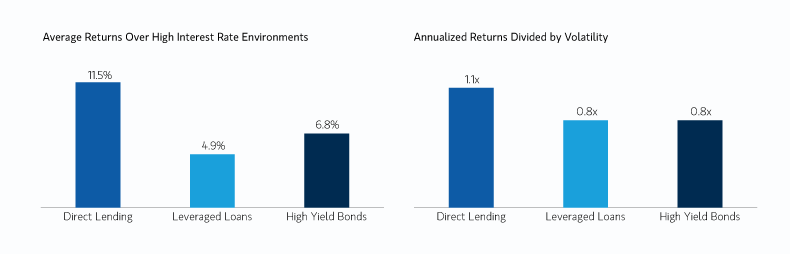
Investor demand for Direct Lending funds remains strong, underpinned by a higher-for-longer interest rate environment. Direct Lending funds have generated superior performance relative to both high-yield bonds and syndicated loans during seven periods of rising rates since 2009.8 Annualized returns divided by volatility, or Sharpe ratio, was also superior for Direct Lending relative to these two asset classes.9 This has not been lost on investors. Surveyed investors have cited Private Debt most frequently as the private asset class they intend to allocate more to.  
 

DISPLAY 2 | Direct Lending, Leveraged Loans, High Yield Bond Return Comparisons
Image
insight_evolution-of-direct-lending_display-4

Source: “Direct Lending” is represented by the Cliffwater Direct Lending Index (CDLI) and is calculated from quarterly data, which has been annualized.  
 

“Leveraged Loans” is represented by the Morningstar LSTA U.S. Leveraged Loan Index calculated from annualized monthly data. “High Yield Bonds” is represented by the ICE BofA High Yield Index calculated from annualized monthly data. High-rate environments are defined as periods of uninterrupted monthly increases in the 10-year US Treasury yield of 75 basis points or more. Return comparisons are based on the average of annualized monthly returns during seven such periods between 4Q’08 and 1Q’23. Volatility is measured using the standard deviation of annualized monthly returns. Ratios are based on the average of all monthly data between Q1’08 and Q4’22.

Learn more about the rise of direct lending from its small, early origins to its present role as a mainstay of the private credit industry.


1 Source: PitchBook, March 31, 2024.  
2 Source: FDIC, as of December 31, 2023. Data from 2000 to 2023, measured by number of FDIC-insured banks.  
3 Source: PitchBook LCD and S&P Credit Pro. Default rates based on the cumulative total of defaults between 1998 and 2023 on broadly syndicated institutional loans (12,223 issuers). Loss rate is calculated using the following formula: Loss Rate = Default Rate x (1 – Recovery Rate). Recovery rate data based on cumulative recovery on defaulted loans in the broadly syndicated institutional market between 1995 and 2023.   
4 Source: J.P. Morgan, Next Street, “The Middle Matters: Exploring the Diverse Middle Market Business Landscape.”  
5 Source: PitchBook, as of June 30, 2024.  
6 Source: Pitchbook LCD Data, as of September 30, 2024.  
7 Source: LESG LPC and Morgan Stanley Research. Represents combined total of BDC and syndicated middle market loan maturities.  
8 Source: “Direct Lending” is represented by the Cliffwater Direct Lending Index (CDLI) and is calculated from quarterly data, which has been annualized. “Leveraged Loans” is represented by the Morningstar LSTA U.S. Leveraged Loan Index calculated from annualized monthly data. “High Yield Bonds” is represented by the ICE BofA High Yield Index calculated from annualized monthly data. High-rate environments are defined as periods of uninterrupted monthly increases in the 10-year US Treasury yield of 75 basis points or more. Return comparisons are based on the average of annualized monthly returns during seven such periods between 4Q’08 and 1Q’23. Volatility is measured using the standard deviation of annualized monthly returns. Ratios are based on the average of all monthly data between Q1’08 and Q4’22.  
9 Preqin Global 2023 Report: Private Debt, January 1, 2023.


IMPORTANT INFORMATION

The views and opinions are those of the author as of the date of publication and are subject to change at any time due to market or economic conditions and may not necessarily come to pass. The views expressed do not reflect the opinions of all investment personnel at Morgan Stanley Investment Management (MSIM) and its subsidiaries and affiliates (collectively the Firm”), and may not be reflected in all the strategies and products that the Firm offers.

This material is for the benefit of persons whom the Firm reasonably believes it is permitted to communicate to and should not be forwarded to any other person without the consent of the Firm. It is not addressed to any other person and may not be used by them for any purpose whatsoever. It is the responsibility of every person reading this material to fully observe the laws of any relevant country, including obtaining any governmental or other consent which may be required or observing any other formality which needs to be observed in that country.

This material is a general communication, which is not impartial, is for informational and educational purposes only, not a recommendation to purchase or sell specific securities, or to adopt any particular investment strategy. Information does not address financial objectives, situation or specific needs of individual investors.

Any charts and graphs provided are for illustrative purposes only. Any performance quoted represents past performance. Past performance does not guarantee future results. All investments involve risks, including the possible loss of principal.

For the complete content and important disclosures, refer to the article pdf.

Share this post

Sign Up Now for Full Access to Articles and Podcasts!

Unlock full access to our vast content library by registering as an institutional investor

Register

Contacts


Morgan Stanley

Morgan Stanley Investment Management’s Insurance Solutions team proudly supports our insurance clients with bespoke investment solutions and a comprehensive range of strategies that align well with insurers’ investment objectives and risk tolerances. We provide risk-based capital efficient solutions across public and private market strategies, and add value through thought leadership across insurance research, portfolio management, strategic asset allocation, reporting, risk management, and rating agency/regulatory considerations.

Joel Cramer, CFA
Managing Director, Head of North American Insurance Solutions
joel.cramer@morganstanley.com
Office: 312 706 4216
Mobile: 630 222 6765
 
1585 Broadway,
New York, NY 10036


View the contributor page

Sign Up Now for Full Access to Articles and Podcasts!

Unlock full access to our vast content library by registering as an institutional investor .

Create an account

Already have an account ? Sign in

Ѐ Ё Ђ Ѓ Є Ѕ І Ї Ј Љ Њ Ћ Ќ Ѝ Ў Џ А Б В Г Д Е Ж З И Й К Л М Н О П Р С ΄ ΅ Ά · Έ Ή Ί Ό Ύ Ώ ΐ Α Β Γ Δ Ε Ζ Η Θ Ι Κ Λ Μ Ν Ξ Ο Π Ρ Ё Ђ Ѓ Є Ѕ І Ї Ј Љ Њ Ћ Ќ Ў Џ А Б В Г Д Е Ж З И Й К Л М Н О П Р С Т У Ф Х Ц Ч Ш Ā ā Ă ă Ą ą Ć ć Ĉ ĉ Ċ ċ Č č Ď ď Đ đ Ē ē Ĕ ĕ Ė fi fl œ æ ß