




We're currently experiencing email delivery delays. For urgent matters, please contact us directly at lindsay@insuranceaum.com.

Income Research-

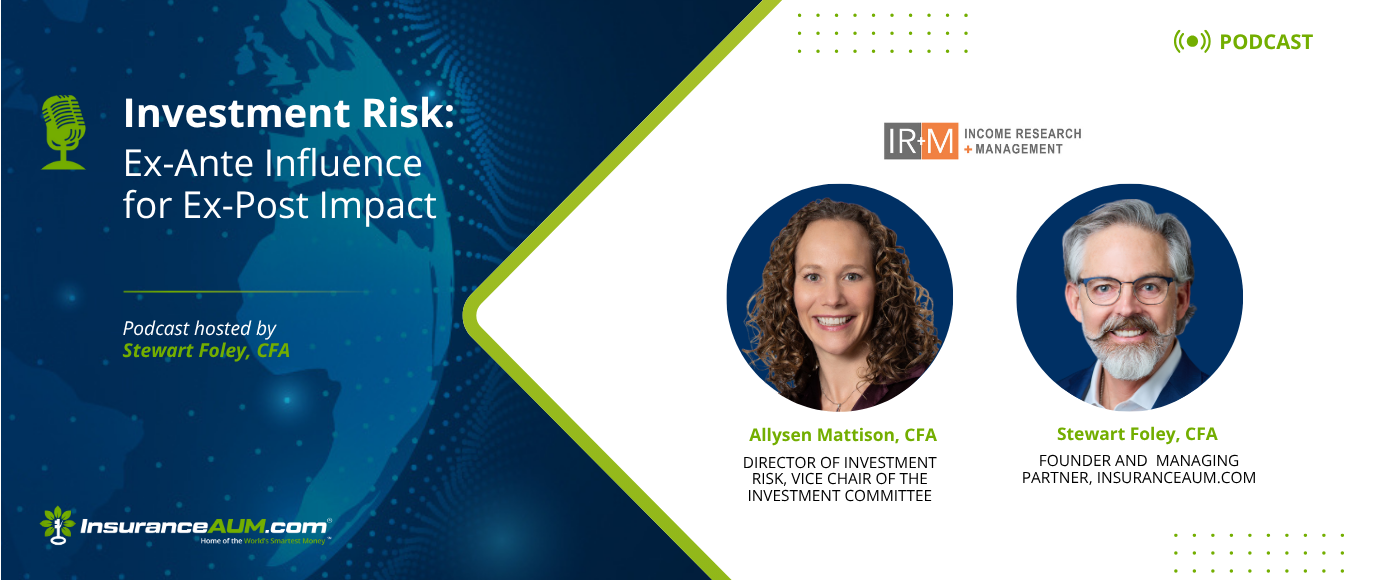
Investment Risk: Ex-Ante Influence for Ex-Post Impact

Image
07.30 Income Research_Web (2)


Stewart: Hey, welcome back. It's great to have you, and we've got a great podcast for you today. The title is very interesting from my perspective, which is Investment Risk, Ex-Ante Influence for Ex-Post Impact, which I love. And our guest is Allysen Mattison, who is the Director of Investment Risk and Vice Chair of the Investment Committee at Income Research and Management. Allysen, welcome to the program.

Allysen: Thank you so much, Stewart. We're really happy to be here.

Stewart: Yeah, we're thrilled to have you. So just for folks who may not be familiar, Income Research and Management goes by IR+M in the industry. Can you give us just a quick synopsis on the firm, and then talk a little bit about where you were born, and then what was your path to getting to the senior position that you hold today?

Allysen: Yeah, sure. So Income Research and Management. We are a Boston-based US fixed-income-only investment manager. We have about 122 billion assets under management, and we've been around since 1987. We just really love bonds. It's all we do. We really like to get in between the wallpaper and the wall, and it's the perfect place for me. I was born in Great Falls, Montana. I went to school at Tufts University. I graduated with a degree in quantitative economics and a minor in math. And as I was sitting in those math classes, I was thinking to myself, “oh my goodness, what am I going to do?” I actually don't want to be an actuary, no offense to all the actuaries on the line, but I had a passion for pursuing the quantitative economics component of my degree, and I found myself on Wall Street, and I worked for a little-known firm called Lehman Brothers.

I was an investment banker, and I worked in the debt capital markets portion of the firm. And I actually helped financial institutions and insurance companies fund debt deals and raise money. And then I transferred onto the desk. The week the Bear hedge funds went under, I went to the sales and trading floor, and I was lucky enough to ride Lehman all the way to the end. You wonder why I have an interest in investment risk. After all of that, I did want to get to the buy side; I wanted to get back to Boston. I landed here at Income Research in Management. I've been here since 2009, and here at this firm I've been in risk, I've been in securitized research and trading, and I'm just happy to be here and happy to be talking to you.

Stewart: Well, I'll tell you, you are in good company because those who have known me a long time know that I am a bona fide bond geek and I'm a fixed income guy for sure. So, in your background in quantitative economics, I have a hole in my head where the algebra goes, and I have so much respect for people who are really accomplished in math, so I'm a little geeked out on that as well. But as the Head of Risk for IR+M, which is, as you mentioned, over a hundred billion dollars in fixed income manager, how do you approach fixed income investment risk?

Allysen: Investment risk is not a risk mitigation function. As active managers, we really need to take those active risks to achieve outperformance. So our goal in investment risk when we're talking to the investment team, when we approach it, is that we're really trying to make sure that the risks that we're taking to achieve that outperformance are well understood and that we really have high conviction in our largest exposures. We want to see our largest risk exposures align with those ideas that we feel will generate the highest performance. And kind of at a philosophical or theoretical level, we think of risk exposures or risk levers the same way you might think of performance levers. And we're really trying to isolate the way that we look at risk in the same way that the portfolio managers are thinking about constructing the portfolios. So we can really make sure that our processes are ensuring that those risk exposures are well understood and what the goal of our function is, is to make sure that the risk exposures that we are seeing are well aligned with the overall risk direction set by our investment committee and that we're elevating any unintended exposures that we wouldn't want to see.

Stewart: I'm going to ad lib something that's a little bit geeky, but bear with me. It always seemed to me that the risk doesn't change nearly as much as the price of risk, and the relative price of risk changes. And part of it is you're identifying the risks, but you're also evaluating how much you're being compensated to bear it, and you're making a very highly informed decision about whether you want to do that or not. Is that fair? What do you think about that concept, basically?

Allysen: I think that's a great way to frame it. So really in two words, you're talking about relative value, you're talking about risk return, and that's really the whole purpose of our function. We want to achieve excellent risk-adjusted performance. We want to be paid, and we want to achieve performance for the risk we're taking. So we understand that certain opportunities could lead to higher potential performance, but those opportunities probably have a wider risk spectrum. Another way to think about risk is as a distribution of outcomes and the performance is what you're hoped for outcome is. But when you're thinking about the opportunity cost of taking that angle to achieve that performance, what the risk function, the risk element is, is to really understand that distribution and say what do you think about the magnitude of those outcomes? What are the probabilities of those outcomes? How might those outcomes interact with other pieces of your portfolio? So I think the way you described it is absolutely perfect. It's really the price of risk and that balance of pursuing that performance objective with that knowledge of risk, versus it's all about the knowledge. And that's why we talk about it's not mitigating risk, it's understanding it.

Stewart: Yeah. Yeah, I think that's really true. I mean, I always coin that I always talked about the greatest risk is the one that you don't know you're exposed to. So you've got to be thoughtful about that. And kind of leads me to my next question, which is what are the main risk exposures that you monitor as a risk manager of fixed income instruments, and what do you believe are most important to track? And I'll kind of tack on, is there anything that you hear people throw around that you think is like not that relevant? Because I think sometimes you get that too.

Allysen: Yeah, I think if we go back to just that performance lever, risk lever framework, at the end of the day, the biggest driver of fixed income returns is interest rates. Bonds are a series of cash flows, and when you break it down to the nerdiest fixed income level, you're discounting those cash flows, and the present value is changing depending on interest rates. So understanding your duration, which is how sensitive a bond or portfolio is to changes in interest rates, is really, really important. And not just the total duration, but also the exposure across the curve, because we know rates don't move in parallel. So understanding where your different interest rate exposures are across the curve is also really important. And IR+M, we believe that it's very difficult to predict and be confident and accurate in the direction of interest rates. So we actually manage our portfolio's duration and curve neutral.

So we're kind of taking that risk off the table, and what the most important risk for us to track, we take a risk decomposition approach. So we're trying to isolate our risk exposures again, sort of in that building block way of the way that we're trying to achieve outperformance with our best ideas. And as far as what's most important to track, I would say that there's not a way from duration is going to impact your portfolio, and you really need to understand that first and foremost. After that, what's most important to track is what's most important to how your portfolio construction method is designed. Because you could have the most sophisticated risk systems and risk technology and partitions and models, but if that's not aligning with how your investment team and your portfolio managers are thinking about the portfolios, your risk function isn't going to be that influential in those anti discussions and having that ex-post impact. So it's really important to make sure there's that alignment between the functions. And I would say that's more important than any one individual metric.

Stewart: Yeah, and I mean, I will put on my faux CIO hat, and I've talked about it. In fact, I just got off the phone with Nico Santini, and I've worked with him for years and we've had this discussion, and I've had this discussion with others. When you are taught finance, and I was a professor for about seven years, when you teach finance and investments, the riskless asset is cash and then blah, blah, blah. Well, that may be the case for a single dimension analysis, but if you're an insurance company, you have cash outflows that are expected across the yield curve and that gives you liability exposure, which can be calculated with key rate durations or partial durations, which is what you were referencing a moment ago, which measures interest rate sensitivity at various parts of the curve. And in my estimation, the riskless position for an insurance company is a key rate, duration, matched dollar duration matched portfolio.

Now you say, well, that's not where I want to be. And I go, I understand, but when you venture away from that, you ought to know why and you ought to know what risks you're introducing, and then what is the price of those risks. And it's exactly what you're talking about, which is that the insurance asset management framework is a two-dimensional framework, and cash is not a riskless asset in most cases. So, interesting. I wanted to join you in the nerdy village. I want you to know, I mean I think it's fair to mention, and I think my friends will agree, a lot of insurance CIOs got cut their teeth in the bond market, no matter how much they may not want to talk about it, they too are fixed income geeks and they too, I mean you can get super nerdy with most of those folks. This is something that I've never honestly understood, and it deals with tracking error. Can you define tracking error first, and then what are some of the drawbacks to managing tracking error targets?

Allysen: Yeah, tracking error is such a good topic to bring up in a risk conversation because often that's sort of a knee-jerk metric that people go to when they think risk. They think, Ooh, tracking error and essentially an ex-ante tracking error model, what it's meant to do, it is used to estimate future return volatility of a portfolio, either versus cash or versus a benchmark. And when you think about the complexity of this model, it's helpful to think about the saying that all models are bad and some models are useful, which means models aren't perfect. And when we think about  ex-anti tracking error models, the way that we think about them is we're really trying to understand what the inputs into the model are. Because a model can be a black box, and if you don't understand how it got to the output, you're not going to understand the output at the end of the day.

As far as explaining the way ex-ante tracking error models work, we like to think about it in a very simple framework with four inputs. There are factors that are defined by the model, and these are exposures to different parts of the market, like short financials, long utilities, high-quality securitized. These are specified by whatever model you're using. The second piece that goes into a tracking error model is what is your exposure to this factor? This is what the manager controls. Are you overweight the factor? Are you underweight factor? Obviously, that's going to impact how the model calculates your overall exposure to it and how it rolls up to tracking error. What the model does is the farther you're away from a benchmark, let's use it in a benchmark context, your biggest underweights, your largest overweights, those are going to increase tracking error because they're bigger deviations.

So bigger volatility differences versus a benchmark. The other two pieces that go into the model are factor volatility. Obviously a factor is more volatile. That's going to increase your tracking error, volatility and then correlations. So the model takes into the fact that asset prices move relative to each other. And we hear in crisis scenarios all correlations go to one. What does that mean? Well, that means that typically in a well-functioning market, some prices go up while other prices go down. So by being exposed to lots of factors, that's that principle of diversification. So if correlations are increasing across all asset classes, you're getting less credit, basically, for diversification. So that's also a factor that will increase your tracking error volatility. So I'm just going to pause there. That was kind of a lot before I answer the third part of your question. Does that make sense? Can I elaborate?

Stewart: Absolutely. And I'm like, Hey, I love it. It is very technical, and it is very important discussion because sometimes what folks are looking for in a performance report isn't as relevant as some things that they're ignoring. You outperformed, okay, good, but why? Did you outperform because you didn't do what you said you were going to do last quarter, and that would've hurt you, or did you outperform because you did do what you said last quarter, and that helped you? It's not just one number minus another number. There's way more nuance to it than that, and it's hard. It's hard to really accurately attribute to the nth degree. Attribution is hard and the attribution of your liabilities that you're funding, that's not easy either. Please continue. It's good stuff.

Allysen: Well, and it's good you bring up attribution and just to continue on the tracking error theme, you asked what can hold you back in a tracking error framework. And if we think about those four pieces that we just outlined and we think about what does drive a higher ex-ante volatility estimate, obviously factor volatility is rising is one thing that's going drive your ex-ante tracking error higher even without you doing anything. But when we pair that understanding of what the model's doing with our economic intuition and we think about what's happening in the market when factor volatility are rising, often that's when the market's selling off and there could be a lot of cheap bonds and there could be a good time to actually buy more bonds and increase your risk and take advantage of those market opportunities. So if you're operating against a very hard ex-ante tracking or budget, the model might be telling you no, you can't take more risk when it might actually be a good time to do so in the market.

And the reverse is also true when we think about what drives tracking error lower without the manager doing anything, it's when volatilities are decreasing, and often that is in a very tight spread environment. And that can be when a lot of bonds are rich, and it doesn't make sense to our previous conversation to take on the downside risk versus the performance upside at those very tight levels. But tracking your budget might tell you that you have a lot of room to take risks because your tracking error has passively come down based on the way the model works and the inputs work. But when you apply your economic intuition, you might actually not want to take more risk at that time. So it's just important to understand what the goals of the portfolio are and how the model may be giving you opposite signals versus market opportunity when you're thinking about how you want to apply something like ex-ante tracking error to your framework.

Stewart: Yeah, that's interesting. I mean, I do think, and one of the things that nobody ever has the ability to calculate is we managed money for a lot of different insurance companies, and there were often unusual provisions in the investment policy guideline, or atypical. And these organizations sometimes have long memories trying to avoid something that negative that happened in the past, blah, blah, blah, blah. But what actually happens is there's a cost to every one of those constraints. And I know that sometimes folks say, well, yeah, that just makes it easier on the manager, but actually there are times when you want to provide the manager with enough flexibility to be able to really execute and deliver on their totality of their expertise. It's hard to measure the impact of those constraints, but there is an impact. You mentioned downside risk before, and kind of fixed income 101 is the quickest way to not underperform or to avoid underperformance, is to avoid losses, right? But there's more to it than that. How do you think about downside risk?

Allysen: Well, you touched on it perfectly, and then again to our prior conversation, you have to take active risks to achieve outperformance. So you have to be willing to take the risk of downside to achieve positive results. And we're always interested, obviously, as the investment risk function in our negative tails. And the way that we like to approach downside risk is similar to our prior conversations. We like to break it down, we like to understand it at a granular level, and this aligns with our bottom-up way that we construct our portfolios. And when we think about downside risk, and when you think about what causes the worst downside events in history, often there's a systematic component to it. And when you're thinking about downside risk, it's important not to be confined to sort of whatever partitions your system or vendor provides. What I'm thinking about when I say that is you don't want to just look at a specific corporate sector's downside risk or a  specific securitized sector's downside risk because if a downside event happens, it's going to impact both of those.

An example is autos. We don't want to look at just our corporate auto exposure and then our ABS auto exposure separately. Both of those asset classes have the same exposure to underlying factors. So you need to think about them together. So when you're thinking about downside risks, you want to have a flexible framework so that you can incorporate things that might have like systematic exposures. So you can think about them in totality of the portfolio and how they might relate to each other. The other thing when we're thinking about downside risk is what do we do when we're in the downside event? And this is where it's really helpful to be in an institution in a framework where you have a very strong research function to lean on, and at IR+M what we like to do, we're not fancy, we just throw a good old stoplight on it.

And whatever the market event dure is, whether it be a spring 2023 banking hiccup, whether it be tariffs, inflation, office, real estate, we'll lean on our bottom-up research analysts and we'll categorize our exposure to this systematic stressor and we'll put our holdings in a simple red, yellow, green framework. And this helps us tune out the noise of the clickbait and the throwing the baby out with the bathwater, and we're able to really isolate what we think the stressors are, and we can look at this then in a total portfolio context and make decisions about if we want to reposition the portfolio. And when we think about these downside risks, what we're looking at, the two key components we're looking at are magnitude and time, and we're thinking about the amount of drawdowns and the speed at which they're happening. But we're also, again, on that point that active managers must take active risk, when you're in down markets, you also need to be thinking about opportunity, and it takes a lot of courage to catch a falling knife.

But that's where the risk function comes in to make sure you have a good understanding of what's happening. We may see a green part of a bad quote sector and say, actually, there's really good relative value argument, Stewart, as you pointed out, you may want to take on that risk. How is that risk priced? So we're also looking at not only magnitude and speed of drawdowns, but magnitude and speed of recoveries and how they relate to each other. Because whatever environment you're in, you want to understand how bad it can get, but you want to understand what opportunity is there for you to have upside coming out of it.

Stewart: It's really a great point because we were managing money in the GFC, and this is a gross oversimplification, but about every subprime mortgage was trading at 60, and some of those were money good, and some of those were worth zero. And it is roll up your sleeves hardcore research that can help you separate the good from the bad, and there's really no substitute for it. It's a good point about opportunities in distress. The other thing that's interesting that you said was when you talked about autos and your corporate exposure and your ABS exposure, I had a client that auto was the only liability they wrote. I was like, Hey, in only five states. And so the next level of risk management at the insurance company level is there. What's known in the industry is clash risk. Is there clash risk between the investment portfolio and the liability book? And is that something to keep an eye on? And those are decisions that get made at the individual company level, but it's the cross-pollination of information between the underwriting function and the investment function. Sometimes it's great, and sometimes it's not as great. And so I think that those are important risk management discussions as well. But final question for you before we get into the fun stuff. How does risk management change for mandates that are less benchmark-centric?

Allysen: That's a great question. When you're providing a wide array of custom solutions, it's really important to understand what the purpose of the portfolio is, what role is it playing? And so we do have mandates that are maybe more total return oriented. Others may be more book yield sensitive, more gain-loss sensitive. And really, throughout our process, regardless of the goals, what's paramount for us is our credit structure price bottom-up philosophy that we're always trying to protect principle. We're always trying to make sure we have return of principle and we're avoiding those impairment probabilities. So that's consistent no matter what. And then when we get into the various nuances of what the objectives of the portfolios are, you may have some risk-based capital considerations. And when we're talking about pricing that risk, that changes the algebra of your return, you have to apply those risk-based capital adjustments onto the potential return.

So that may change the relative attractiveness of certain asset classes versus the risks that they have for certain portfolios, if that's a consideration. Another big one that we come up with a lot when we're thinking about these type of portfolios is liquidity. So certainly understanding if there are gain-loss constraints, if there needs to be more of a long-term approach, if it's more of life liabilities, or if you need to have claims payments and liquidity in the portfolio to meet those. All of those are considerations for a sort of what types of asset classes we're putting in the portfolios. Obviously, no two insurance portfolios are alike, so we just really think it's important to develop that partnership with the client to really understand those objectives. How is this portfolio fitting into the strategic asset allocation? What are the constraints? What are the sensitivities, what are the goals? And then we're going to apply our expertise in all of these risk areas to make sure we craft a custom solution and those risk exposures that are going to best meet those objectives.

Stewart: A masterclass on fixed income risk. Really, a great job here. Anyway, listed. Here are a couple of fun ones. This really tries to speak to the culture at IR+M, and you've been there since 2009. So a lot about what I'm going to ask you, which is what are the characteristics you look for when you're adding to your team? Not the hard skills, but what characteristics are important at IR+M? 

Allysen: Such a great question. Love this question. It's so important for us when we're hiring. Obviously, we want people who know what they're doing and love bonds. That's number one. Loving bonds as much as you do, Stewart. If you want to apply, we'll get some open roles for you.

Stewart: Yeah, I'll call up Rob Lund. Go, Hey, listen man, you guys need anybody to just talk about bonds today?

Allysen: So for us, we really thrive in this team environment and we have two sayings that come to mind when I think about hiring and it's ‘firm, team, self,’ and ‘ever better.’ So we're looking for those individuals that can excel but don't have an ego, that have that humility can be part of the team, and are always looking to push us. We love individuals that have that just wide-ranging sense of curiosity and are looking to make themselves better, but also make the team better and are able to identify areas that we can improve a new idea, something we can do different with our processes and they're bringing solutions. So we really don't look for those candidates that are just brilliant, but sit back and do their own work. We're looking for someone to be part of the team to contribute to the team and make us even better.

Stewart: Yeah, it makes sense as long as you guys don't have a mustache restriction, I'm in. Alright, so listen, last one, fun one. You can have dinner with up to three guests. They can be alive or dead. Doesn't have to be three. You can have one, two, or three. Who's coming to dinner with you, Allysen?

Allysen: I would love to have dinner with Jeanette Rankin. She is from my home state of Montana, and she is the first woman who was ever elected to Congress in the early 1900s. So just to hear her grit, resilience, perseverance, what that journey must have been like, and she must have done something right. She was elected for a second term. I think it would be so awe-inspiring to have dinner with her and also get to chat about Montana, of course. And then I always love pairing left brain and right brain together when we talked about thinking about risk and having to think outside the box. I love art, and I would love to invite a gentleman named Kaji Aso. He was a Japanese artist who started a small art studio here in Boston that I was lucky enough to be a student of, and I just so respected his teachings about nature and observing beauty and that harmony and peace. So, I think that he would bring a nice complement to the very intense discussion I would expect with Jeanette. And last but not least, I would have to invite my dad. He passed away over a decade ago, and he actually sold insurance. He sold life policy. So I would just love to chat with him, talk about how the industry has changed, and as you pointed out, talk about how that liability side and asset side fit together, and get his perspectives on that for what I'm doing now for selfish reasons.

Stewart: That is amazing. And don't tell me, are you seriously a fixed-income geek that paints?

Allysen: Yes. Yes.

Stewart: Holy smokes.

Allysen: I do watercolor.

Stewart: That is a very, very small Venn diagram. That is a tiny sliver in there. If there are any other fixed-income painters out there when we post this on LinkedIn, please make yourself known. Very cool. Really, a great, great job today. Great podcast with you, Allysen. Thanks so much for being on today.

Allysen: Absolutely. Thank you so much for having me.

Stewart: My pleasure. We've been joined today by Allysen Mattison, who is the Director of Investment Risk, Vice Chair of the Investment Committee at Income Research and Management. Thanks for listening. If you have ideas for podcasts, and you'll be shocked at how few emails I get, I'm going to stop saying this. Shoot me a note at Stewart@insuranceaum.com. Please rate us, like us, and review us on Amazon, Spotify, or wherever you're listening to your favorite shows. You can also watch us on our new YouTube Channel at Insurance a community. Thanks for listening. We are the home of the world's smartest money at InsuranceAUM.com.

Share this post

Sign Up Now for Full Access to Articles and Podcasts!

Unlock full access to our vast content library by registering as an institutional investor

Register

Contacts


Income Research

IR+M is a privately-owned, independent, fixed income investment management firm that serves institutional and private clients. Our investment philosophy and process are based on our belief that careful security selection and active risk management provide superior results over the long-term. By combining the capacity and technology of a larger firm with the culture and nimbleness of a boutique firm, we strive to provide exceptional service for our clients and a rewarding experience for our employees.

Rob Lund, CFA
SVP, Senior Client Portfolio Manager
rlund@incomeresearch.com
617-330-9333

www.incomeresearch.com
100 FEDERAL STREET
30TH FLOOR
BOSTON, MA 02110


View the contributor page

Image
IRM_icon

Sign Up Now for Full Access to Articles and Podcasts!

Unlock full access to our vast content library by registering as an institutional investor .

Create an account

Already have an account ? Sign in

Ѐ Ё Ђ Ѓ Є Ѕ І Ї Ј Љ Њ Ћ Ќ Ѝ Ў Џ А Б В Г Д Е Ж З И Й К Л М Н О П Р С ΄ ΅ Ά · Έ Ή Ί Ό Ύ Ώ ΐ Α Β Γ Δ Ε Ζ Η Θ Ι Κ Λ Μ Ν Ξ Ο Π Ρ Ё Ђ Ѓ Є Ѕ І Ї Ј Љ Њ Ћ Ќ Ў Џ А Б В Г Д Е Ж З И Й К Л М Н О П Р С Т У Ф Х Ц Ч Ш Ā ā Ă ă Ą ą Ć ć Ĉ ĉ Ċ ċ Č č Ď ď Đ đ Ē ē Ĕ ĕ Ė fi fl œ æ ß