





We're currently experiencing email delivery delays. For urgent matters, please contact us directly at lindsay@insuranceaum.com.

Morgan Stanley Investment Management-

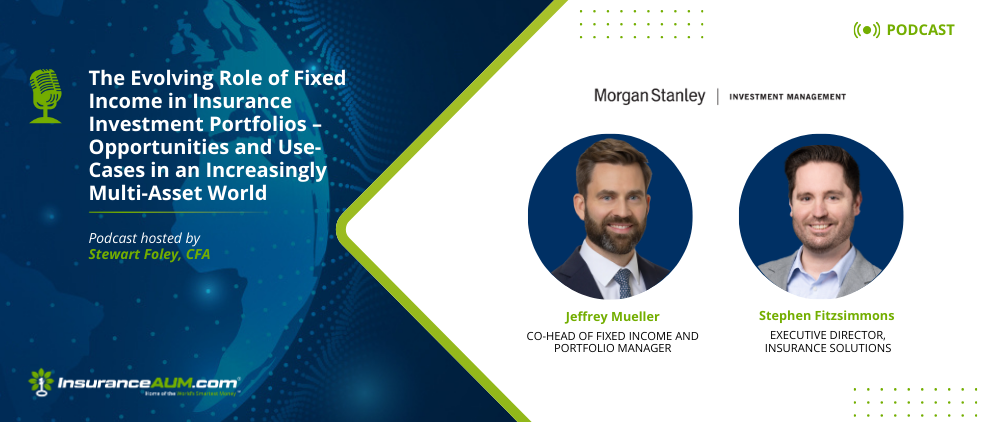
The Evolving Role of Fixed Income in Insurance Investment Portfolios – Opportunities and Use-Cases in an Increasingly Multi-Asset World

Image
08.14 Morgan Stanley_Web (1)


Stewart: Hey, welcome back. It’s been a minute since I've done a podcast. We are just coming back from the NAIC National Meeting in Minneapolis. It was the first one for me. I'd never been to an NAIC meeting. I learned a lot. I got a chance to say hello to Commissioner White, who's the president-elect of NAIC. I also got a chance to say hi to Carrie Mears and Nathan Houdek, so I want to say a big shout-out to them. That is a massive meeting. It was really interesting to see how insurance regulation is done firsthand, and I'm looking forward to being back. So everyone was super nice there and really appreciated the hospitality. We have another episode of the insuranceaum.com podcast for you today. My name's Stewart Foley, and I'm the founder of InsuranceAUM. The title of today's podcast is the Evolving Role of Fixed Income in Insurance Investment Portfolios - Opportunities and Use Cases in an Increasingly Multi-Asset World, which is a mouthful. Our subject matter experts for today's show are Jeff Miller, Co-Head of Fixed Income and Portfolio Manager at Morgan Stanley Investment Management, and Stephen Fitzsimmons, who goes by Fitz, Executive Director and Insurance Solutions, also at Morgan Stanley Investment Management. Gentlemen, welcome. Thanks for taking the time. Welcome to the show.
 

Stephen: Excellent to be here, Stewart. Thank you for having us.

Jeff: Yeah, fantastic to be here, Stew. Glad to be here again.

Stewart: Yeah, no, it's good. It's good to have you back. We kind of want to get to know our guests a little bit. I think it's important for folks to know who they're listening to, so that leads me to our first two questions, which are: Where did you grow up? And this is new for us. What was your first concert, Jeff? I'll start with you.

Jeff: Oh, what a question, Stewart. This one is cut straight to the heart. I'm from the great state of Wisconsin and I like to describe that to people as upper middle of nowhere but good people and good musical taste because obviously my first concert was the New Kids on the Block at Alpine Valley in 19, I'm forgetting the year, but it was a heck of an experience as an early teen back then, so it's a good memory of mine.

Stewart: That's amazing. Some friends of mine got married at Alpine Valley a couple of summers ago. How's that for a small world? How about you, Fitz?

Jeff: I think plenty of the listeners may be familiar with Alpine Valley, great history of musical greatness in terms of concerts and artists who played there over the years. I'm not sure New Kids on the Block is going to rank high for too many people, but look, it was an experience. It was a formative experience. I'll tell you that.

Stewart: You're in a friendly environment, Jeff. There's no judgment whatsoever here. Fitz, I know you wouldn't give him any grief about that. Where'd you grow up, and what was your first concert?

Stephen: Not at all. I grew up in the insurance capital of the world, Hartford, Connecticut, and I will say it's still the insurance capital of the world even though some may disagree with me at this point in time. And my first concert was actually Audio Slave, which you may remember as a combination of a supergroup of sorts, Chris Cornell from Sound Garden, and the rest of the band were the members of Rage Against the Machine that were not Zach de Rocha.

Stewart: Wow.

Stephen: So excellent first show. 

Stewart: That's great. That band… That is a serious band. I've listened to some of their stuff in the past that is a serious band, no doubt about it.

Stephen: Yeah, I would say Chris Cornell is probably one of the best rock vocalists to ever have walked on this planet, and I'll take that to my grave as well.

Stewart: Yeah, that's absolutely true. Let's start off with macro and ALM optimization. And Jeff, I want to start with you. We're recording this ahead of a Fed meeting where the futures market is heavily leaning toward a cut. Talk to us about how you're viewing the current interest rate inflationary and broader macro environment right now.

Jeff: It's an easy question to ask, and it's probably a more difficult question to answer, Stewart, just given all the moving pieces.

Stewart: That's why I'm on this end of the microphone, Jeff.

Jeff: I like that. I like that. I mean, look, I think if we take a step back and we look at what has transpired over the course of this year, obviously new administration coming in, I think the idea and the cadence of views of okay, we're going to get some growth positive metrics and maybe we'll get some more challenging things that will happen on the trade side. I think first and foremost, maybe the sequence of that was different than people expected with a very aggressive trade stance coming out of the box, certainly earlier this year and some of the better news, whether it be around deregulation or tax cuts, taking a little bit further to feed through, but it's obviously led to what has at least been a volatile picture on the macro side if not so much in financial markets because despite a lot of what's been going on under the surface here, markets have obviously together pretty well, but I think we're in an environment where unbalanced growth expectations have fallen from where people expected them to be.

I think in the margin inflation expectations have risen again, partly because of the trade policy we've talked about, the tariff policy, and the volatility around that, which everyone is aware of and frankly probably sick of hearing about and thinking about. And then we are also dealing with things that historically, at least in the recent past there haven't been much concerns around but maybe there are now and that's just the fact that some US institutional norms have either been threatened in the case of the independence of the Fed or in some cases there's been a practice put there changing out the head of the Bureau of Labor statistics. So they've just been, regardless of what your political views are, some things happening in the market that have been non-standard compared to previous history. And so again, that has an impact. I think where we are now.

I mean you mentioned it, we've got a fed meeting in September, we've got the future markets. There are obviously pricing in cuts at that meeting and there certainly was debate going into today around ‘would that be a 25 basis point cut? Would that be a 50 basis point cut?’ I think PPI today, if you disaggregate those components, it's maybe not as concerning as you would think to the Fed because of what feeds through. And if you actually look at the goods component of that, it's up a relatively modest 0.4%, but at the end of the day, the Fed is in this challenging environment where growth appears to be slowing, the labor market appears to be weakening and certainly the print that we saw in the revisions in previous months would back that up and those cuts are coming in. So I think if we continue to see the labor market weaken, I think we're going to continue to see the Fed be on the front foot there and be willing to cut, but are they going to cut as much as the market's pricing, whether that's two and a half or three cuts this year and getting all the way down to 3%.

I think we need to see a little bit more play out this year, particularly on the inflationary side. I think initial inflationary concerns will be easily overlooked by the Fed saying, look, it's one times this isn't an underlying demand issue with excess demand, but it's really a supply side issue on the inflationary side, but if we see those inflationary pressures really become a little bit more sticky, then it creates a little bit more of a challenging environment. I think in portfolios and in our view, we've certainly had the view that curves were going to steepen whether that was because fiscal concerns overall from a fiscal sustainability standpoint for the US or whether that was because of inflationary dynamics, but also because we felt like the Fed would eventually be in a position to cut rates as the labor market weakened. And I think we are in that place now, but I will say curves have obviously steepened pretty precipitously here over the last couple years, but certainly in the last several months and with that five thirties now north of a hundred basis points, we think there's an opportunity probably to take a little bit of profits there and duration might look a little bit more interesting where we are right now.

Stewart: Fitz, let's build on that in the context of a potentially steeper yield curve and a Fed cutting cycle. How should insurers be thinking about ALM optimization right now?

Stephen: Yeah, that's a great question, and I think Jeff touched on a lot of really interesting factors there that are leading into our thinking today. The easy answer is term premium has not been a thing in the market for a while. One only needs to go back to last summer to see a negatively sloped two-thirties curve, and now we're seeing a two-thirties curve north of a hundred basis points. So what we're thinking is there may be an opportunity within public fixed income without getting too cute to add duration to portfolios where insurers may have been happy to kind of play at that shorter end of the curve for a while because there hasn't been any term premium, but this gross steepening that we've seen, the profits that could be taken on fairly consensual steeper trades that can happen now and you can start rotating into a little bit more duration and truing up any ALM gaps that have formed over the past couple of years while you've been picking up spread and yield on the shorter end of the curve. Very simple approach, and we think that's kind of keeping it simple, stupid for an easy insurance trade in the public fixed income market, something that's kind of reemerged recently.

Stewart: Yeah, and I think when you take that into kind of our next topic, which is cross-sector fixed income views in an insurance context, and Jeff, given the macro background, give us your view on public fixed income right now. Where are the opportunities, and where should insurers be more cautious?

Jeff: Yeah, I think it's obviously a great question, just given the market backdrop we've been talking about. I mean, what I would say is a general comment. We're certainly dealing with an environment where credit spreads are relatively tight and you look across the credit space, whether that's investment grade, sub investment grade or securitized space, and we see that, but yields all and yields are still relatively high and I think we've seen a lot of yield based buyers come into these markets, continue to provide support and I think we will, but obviously we think there's some parts of the market that are a little bit more attractive than others. The investment grade space right now, we've seen spreads compressed materially there, around 80 basis points in both the US and Europe, so relatively tight markets still prefer financials over industrials in these markets and have a preference for Europe over US or European-exposed businesses.

I think some of the fiscal spending that we expect to see coming, not least of which from Germany, but across the rest of Europe, is going to drive some opportunities even in US dollar-denominated securities of some of those European businesses, so prefer Europe over the US, and investment grade prefer financials over industrials as well. I think as you come into the sub-investment-grade parts of the credit market, whether that be loans or high yield, again, it's really an all-in yield story. Their spreads are tight, particularly in the high-yield market inside 300 basis points, as we know. So we would certainly view a need to come to these markets because of the all-in yield opportunities around 7%, but when you get here, make sure that you're taking a risk-conscious approach to doing that in an active way, and I think that's the way we're approaching these markets and thinking about them. On the loan side of the equation, their spreads look a little better, but of course if we're going to be pricing in fed cuts going forward, then your actual yield that you will earn in those areas obviously will come down a little bit.

You're also dealing with a dynamic in that loan market where the quality of the market has shifted somewhat materially over the last several years. That used to be a very heavy BB market, and that has shifted to be almost a 70% single B market right now. So being mindful of the underlying credit risks in those markets, we think there's great opportunities in that single B part of the market, but if we were going to pick one part of the loan market for investors to get exposure to, it would really be in the CLO space where yes, CLO spreads have tightened a bit and yields have come in, but you're still getting paid a complexity premium, you can still have full transparency into the underlying collateral and drive returns that we think on a risk adjusted basis are going to look pretty attractive. So in the corporate space, that's really how we're viewing the world.

Stewart: That's super helpful. Fitz, as you know well, and so does our audience, even if crystal ball was perfect, it still requires a considerable amount of expertise to implement a strategy in an insurance context, and as I know you've seen one insurance company, you've seen one insurance company, so can you talk about how the implementation side, particularly in the context of a changing regulatory environment?

Stephen: Yeah, that's a great question. I mean, let's take the last thing Jeff said there, right? If you were to just kind of take an absolutist alpha approach to the market, you would say, yeah, let's add some CLOs here, and that makes a ton of sense, but if you kind of think about the regulatory changes that are happening here in the us, the kind of sweet spot for insurers in the CLO market at the A, BBB, sort of that higher mezzanine part of the stack, those are going to start being treated a bit more punitively potentially with these upcoming regulatory changes with the NAIC. As such, and also given fairly narrow credit curves between one trach to the next, it actually may make more sense for insurers to target that AAA and AA part of the stack where you can pick up still some incremental spread through the discount margin versus IG corporates or whatever your comps may be, but you're not as exposed to what that regulatory change might look like for you.

I think that's one really important consideration, and another one, as you take a further step back, your universe of comparables as an insurance allocator isn't confined to one asset class or a narrow scope or a narrow space. You're also comparing these trade opportunities to things like private credit and alternatives, and if you think about the primary reasons for buying private credit and alternatives, a lot of them are you sell liquidity in order to buy spread, buy complexity, et cetera. We also see spreads in the private credit space narrowing, and you have to be very selective about where you want to play private credit these days. If direct lending is in the seventh or eighth inning and things like fund finance are in the fourth or fifth inning and then broader ABF sectors and CFOs are maybe a little bit earlier on in the ball game, those are maybe areas where you should consider playing if you're going to play in the private credit space as things sort of fill up on direct lending and those spreads compress and those types of things become commoditized.

The big theme we're seeing is sort of this efficiency that we've seen incorporated into the public fixed income market now starting to proliferate corners of the private credit market. And if you talked to any private equity guy on the street that has a private credit arm, they would tell you that someday there's going to be a very robust secondary market for private credit. Though that may be the case, the second-order effect of that, in our view, is that that should have an incremental tightening impact on the overall spreads you can obtain in the space. So you have to be very selective. You have to pick managers you really like if you're going to play in that sort of private credit space as a part of your multi-sector fixed income portfolio solution.

Stewart: Yeah, I mean, I think just one person's opinion here, but just from a supply and demand perspective, and the more liquid that market gets, it stands to reason that spreads are going to be reduced. I mean, it's hard to see another way around it. Jeff, let's talk about the evolution of transparency and fungibility in public fixed income markets. How has it changed in recent years, and how does it affect portfolio construction for insurance companies?

Jeff: Yeah, I think it's a great question, and it really dovetails with the point that you and Fitz were just talking about there. I mean, I think as you have a market that number one matures, number two has more institutional ownership across it, more familiarity, more history, and importantly increasing liquidity dynamics, then these asset classes really start representing the pure underlying risk factor of why you invest in them. And so, for example, if you're investing in corporate credit and you have a liquid market, then really what you get paid for is that credit risk. I think when we think about these markets, again, I think the all-in yield opportunities that are available in fixed income right now are reflective not of liquidity dynamics, but of the actual ability to harvest credit risk premium overall. That's something that we think should have value for investors. When you look at what's on offer, that is what you're going to get.

You're not getting paid for a bunch of hidden risk factors that you don't understand or may not be able to price appropriately. And I think that's important, and it's important in a portfolio context because you can do relative value analysis across all those different parts of the market to assess where does it make sense for me to be right now, and why does it make sense to be there? So I think we see an increasing demand, again from an all in yield perspective, but also from an investor base who's comfortable with the transparency in these asset classes, who recognize that the liquidity dynamics have changed over time and it makes it a more useful and transparent tool for achieving what investors want to achieve in their portfolios.

Stewart: Yeah, I mean, that's super helpful, and Fitz, I want to come back to you. It's funny how markets work, and it sort of like, and I've been at this for a minute, it's kind of like having a bunch of people in a canoe, right? It's like some of us can look over the right side, but if we all look over the right side, that's not going to work out well. And so what I guess I'm getting at here is, can you talk about how you compare that to what you're seeing in the ongoing evolution of private credit in the insurance space? And you mentioned the seventh or eighth inning indirect lending, but how do public fixed income allocations complement private credit? Can you help us think about that?

Stephen: Yeah, this is actually a topic very near and dear to my heart. I think back to 2022, a time we all probably remember very well, where you had credit spreads widening and interest rates rising in a pretty meteoric fashion. And I was at a life insurance company at the time, and if you were a life insurance company that had a very assertive growth trajectory and a reinsurance arm, you would have fairly robust allocations in your SAA framework, your strategic asset allocation framework, for things like private credit and alternatives. And you strike these sorts of agreements to invest in these sectors at prevailing levels at the time that you enter into the agreement. So then you get capital called over some period of years down the line after you negotiate whatever it is you're going to invest. In 2022, what I noticed was that as these spreads and rates were gapping out in the public market, there were opportunities to buy single A, BBB CLOs at a cheaper level than what I was getting in the private credit space, particularly within direct lending.

And why I think that's important is, as that obviously isn't always the case, but I think as insurers are striking these strategic asset allocations, it's very important to be mindful that this is more of a marathon than a sprint. There's so much impetus in the market these days. If you think about the compound annual growth rate of reinsurance, it's got, it's in the high teens or low twenties percentage. Traditional insurance is like in the single digit percentage, and every time a new reinsurance transaction is inked, it creates what I call a catalyzing event where the economics of the asset portfolio that comes over with that reinsurance agreement has a new target of a spread that it needs to achieve or an IRR that it needs to achieve. And this creates a bit of a food fight, a road race to see how many spread assets you can cram into that portfolio as fast as humanly possible.

And the mantra that we've had with our clients is being very mindful about how you allocate to private credit with the utilization of public fixed income as a sort of buffer and buoy along the way, particularly when all-in yields are as high as Jeff has been indicating. When you're in a very complex reinsurance type of construct and you have many legal entities that roll up to your life insurance company - many reinsurance treaties like funds withheld, comfort trust, et cetera, that need to be collateralized on an ongoing basis - you'd be very thoughtful about where you're placing those private credit assets and compliment them with spread from your public fixed income portfolio, which I think we're giving a couple pretty compelling arguments about where you can do that today. It's really just an exercise of caution at Morgan Stanley. We have all of these strategies, and we're very proud of our capabilities across sectors that include private credit and alternatives, but it needs to be a thoughtful approach that takes the liabilities and the nature of the insurance business in mind. Like you said, if you've seen one insurance company, you've seen one insurance company, and what it looks like today, this industry, I've been doing this for what, 10, 11 years now. It looks so different from it did back when I started, and it's exciting. It's very exciting. I love talking about it. I love being a part of it as I'm sure you do too, but there's just a lot to be cognizant of.

Stewart: Yeah, the one difference is that for the first 25 years of my career, it was somewhat status quo, and then in the last five years, it's like we hit the afterburners and all of a sudden everybody wants to be in the insurance asset management business.

Stephen: Exactly.

Stewart: Which is great for Insurance AUM, believe me, we're tickled. I want to go back to you, Jeff, and this is kind of, I don't know, kind of a hard question, I think, which is what's one piece of advice that you'd give insurance CIOs today as they navigate this increasingly complex multi-asset world?

Jeff: Yeah, it's obviously the right question to ask, and look, I think from my perspective, the most important thing is number one, have a sober view of reality and likely returns going forward across asset classes. That's number one. And number two is to find partners. Find partners you can trust. Find partners who have the same vision as you, who understand what you are trying to achieve and why you're trying to achieve it, and who share a vision of the world as you, but also people who will challenge you. I think that's the most important thing because in a world where we have volatility, where we have choice, where we have innovation, we have a lot going on around us, there needs to be an ability to stick with the times to continue to learn to to grow, but you also need people and institutions around you you can trust so you can actually deliver for your stakeholders.

Stewart: Yeah, super helpful. Fitz, how about you? Same question. What is one key takeaway for insurance investors listing right now?

Stephen: I think in today's world, more so than I've ever seen before in my career, you have more stakeholders and constituencies as an insurance CIO than you ever had before, and your investor base, and in some cases, the blocks of business in the way they grow is so different than the way they were before. So your liability profile is different than it was the way before. It's more dynamic than it was back in the past, with all the transactions that are happening, either legal entity lift-outs or reinsurance transactions. And I think my biggest piece of advice from my own experience would be to kind of just stick to your knitting and that, I think for the longest time, the mantra of insurance has been first do no harm. I know back in the day in my old firm, that was one of our mantras, and I think that's still true today, and I think it gets a bit lost in the shuffle.

Folks try to hit very aggressive SAA targets, and maybe certain investment teams get compensated whether or not they hit those targets or achieve a certain level of spread uplift. But I think the struggle now more than ever is to, as an insurer, particularly with multi-manager approaches and many different new esoteric asset classes that they're allocating to, is to fully understand the risk that they're adding to the portfolio. We have a lot of smart people out there doing a lot of really smart things. It's just I think it needs to be a more methodical approach, where you measure twice or three times and then cut once, and that can get lost in the shuffle as this industry grows in a way that's much more exponential than it ever has in the past.

Stewart: That's great advice from you both, and thank you for that. My next question, I've got a couple of fun ones out the door that aren't necessarily related to an asset class, and the first one is intended to really get at the culture at Morgan Stanley, and it goes like this. What characteristics are you looking for when you're adding members to your team? Not the school, not the hard skills, but what characteristics do you find are a good fit for your team at Morgan Stanley?

Jeff: It's one of the most important things we think about, Stewart, and we've spent a lot of time over a lot of years dialing in on that. And I think a lot of it boils down simply to clearly you need people with intelligence. Clearly, you need people with drive and the willingness to work hard, but you need intellectual curiosity and you need passion because that is what translates into the hard work and ultimately the aptitude. I mean, one of the things we always talk about is the people who are best at investing in my experience are those who don't view this as a job, but they really view this as a lifestyle. I mean, that's how I grew up in this industry. Every single interaction I have in my life, whether it's in the office, outside the office with my wife, with my children, with my friends on the weekend, you can always relate it back to investing. And my mind is always turning. The wheels are always cranking. I think it is those people who really, really embrace this and view it that way, who ultimately make the best investors and, at the end of the day, drive the best return. So, for us as an investment house where investment excellence and client service are the two things that we make all our decisions around, that's something. The correlation between finding people who view the world that way and ultimate success as investors has been incredibly high. So we continue to focus on that.

Stewart: It's interesting because, as a finance prof for seven years, you do find students who are really into it, they don't think it's a homework assignment, they cannot wait, they live and breathe it. And that's the first guest that's ever really kind of pointed that characteristic out. But there are folks like that for sure.

Jeff: I think so. And again, that doesn't mean that they know everything, but it means they're willing to learn it, and they have an insatiable desire to learn. And I think that's it. Again, we've all got to keep an open mind, keep learning every day, keep getting better, and that trait, like I said, has a high correlation between that trait and being able to do that.

Stewart: Yeah, it's okay. So the last question. So whenever we have two guests, we have to modify the last question just a little bit. So this is dinner for guests alive or dead, and the rules are this: you each get one, and then you guys have to agree on one. How about that? So that'll be fun. Alright, so fits. Who do you want to have dinner with? Alive or dead?

Stephen: So, not to get too misty-eyed, but about 11 years ago, we lost my mother, and today would've been her birthday. So, in honor of my mom, Gina Fitzsimmons, shout out. I would like to say that if I could have dinner with anybody, it would be her.

Stewart: Absolutely. And happy birthday. That is really touching. It really is. Alright, Jeff, the tough one to follow. Go ahead.

Jeff: Yeah. Wow. Really put me in a tough spot here, Fitz.

Stephen: Sorry, dude.

Jeff: That is incredibly touching and happy birthday. That is incredible for me, honestly, I think I got to get a little bit of credibility back after my New Kids on the Block concert. I think for me, it may sound silly, but I think Bob Dylan would be the one person whom I would love to have dinner with, the best songwriter of all time. He's seen a few things that have gone down over a period of history here, both in the music industry but also elsewhere. And an incredibly interesting human being who once again is someone who has viewed their craft as a lifestyle rather than a job. And I think there'd be plenty to learn and certainly plenty of stories to hear.

Stewart: That's super cool. Okay, so wait a minute, I'm kind of losing track. I'm all mixed up with the last answer. So, is there one that you guys could get together on for the two of you? You've got Fitz's Mom and Bob Dylan, and just right there, that's a heck of a dinner.

Jeff: Sounds like a great dinner to me, to be honest.

Stewart: Yeah, I mean, we can call it good there if you want.

Stephen: I mean, I was going to say let's add Chapel Roan to it. She just seems like fun to me.

Stewart: There you go. Alright.

Jeff: I can be down with this.

Stewart: There we go. That's fantastic. Well, we've gotten to an agreement. That's great. So listen, a lot of fun today guys. Thanks so much. Our subject matter experts today have been Jeff Miller, Co-Head of Fixed Income and Portfolio Manager, and Stephen Fitzsimmons, Executive Director in Insurance Solutions, both at Morgan Stanley Investment Management. Guys, thanks so much for sharing your views, and thanks for taking the time.

Stephen: Yeah, thanks for having us, Stewart.

Jeff: It's been great. Yeah, cheers. Thank you so much.

Stewart: Thanks for listening. If you have ideas for a podcast, please shoot me a note. It's stewart@insuranceaum.com. Please rate us, like us, and review us on Apple Podcast, Spotify, or on our brand new YouTube channel at Insurance AUM Community. My name's Stewart Foley. We're the home of the world's smartest money at insuranceaum.com.


Share this post

Sign Up Now for Full Access to Articles and Podcasts!

Unlock full access to our vast content library by registering as an institutional investor

Register

Contacts


Morgan Stanley

Morgan Stanley Investment Management’s Insurance Solutions team proudly supports our insurance clients with bespoke investment solutions and a comprehensive range of strategies that align well with insurers’ investment objectives and risk tolerances. We provide risk-based capital efficient solutions across public and private market strategies, and add value through thought leadership across insurance research, portfolio management, strategic asset allocation, reporting, risk management, and rating agency/regulatory considerations.

Joel Cramer, CFA
Managing Director, Head of North American Insurance Solutions
joel.cramer@morganstanley.com
Office: 312 706 4216
Mobile: 630 222 6765
 
1585 Broadway,
New York, NY 10036


View the contributor page

Sign Up Now for Full Access to Articles and Podcasts!

Unlock full access to our vast content library by registering as an institutional investor .

Create an account

Already have an account ? Sign in

Ѐ Ё Ђ Ѓ Є Ѕ І Ї Ј Љ Њ Ћ Ќ Ѝ Ў Џ А Б В Г Д Е Ж З И Й К Л М Н О П Р С ΄ ΅ Ά · Έ Ή Ί Ό Ύ Ώ ΐ Α Β Γ Δ Ε Ζ Η Θ Ι Κ Λ Μ Ν Ξ Ο Π Ρ Ё Ђ Ѓ Є Ѕ І Ї Ј Љ Њ Ћ Ќ Ў Џ А Б В Г Д Е Ж З И Й К Л М Н О П Р С Т У Ф Х Ц Ч Ш Ā ā Ă ă Ą ą Ć ć Ĉ ĉ Ċ ċ Č č Ď ď Đ đ Ē ē Ĕ ĕ Ė fi fl œ æ ß