





We're currently experiencing email delivery delays. For urgent matters, please contact us directly at lindsay@insuranceaum.com.

Morgan Stanley Investment Management-

The Low Rate Environment Could Impact Products and Investment Portfolio Mix

Image
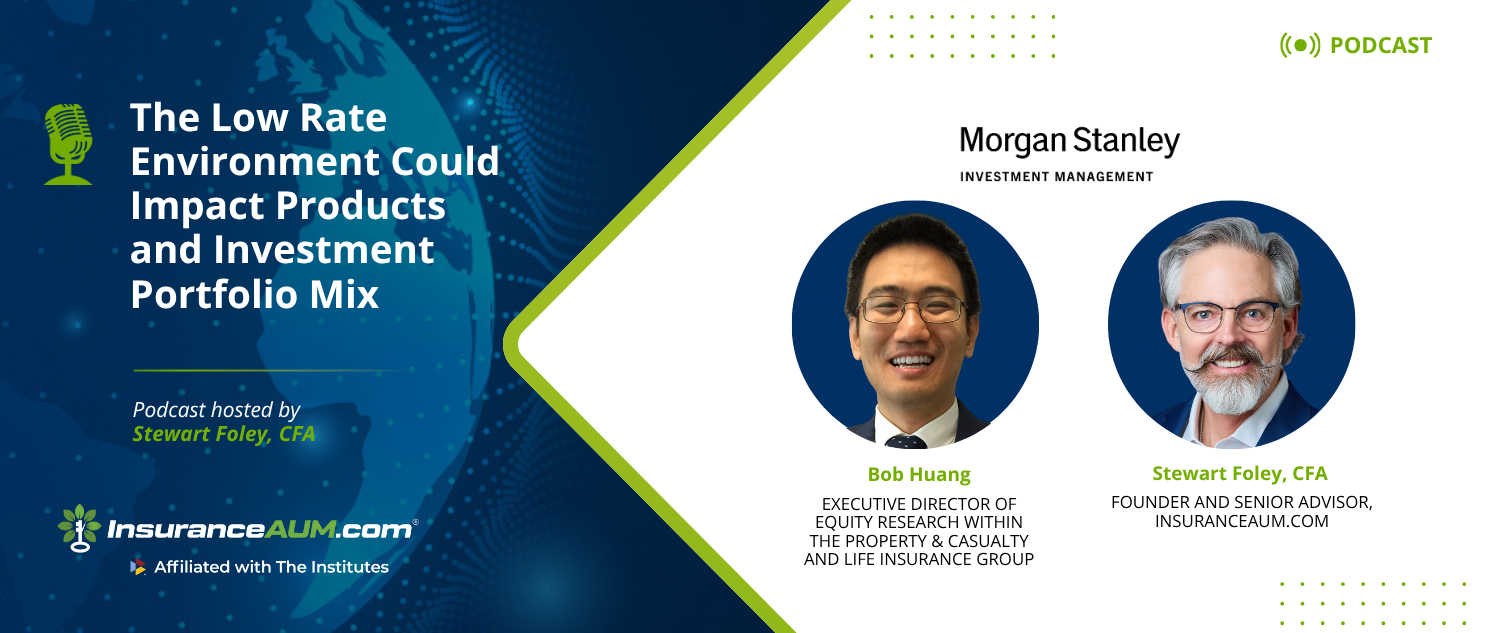
The Low Rate Environment Could Impact Products and Investment Portfolio Mix header image


Stewart: I'm Stewart Foley, and this is the InsuranceAUM.com podcast. Let's get down to the business at hand today. The title of the podcast is “The Low Rate Environment Could Impact Products and Investment Portfolio Mix.” I'm very excited about our guest, Bob Huang, Executive Director of Equity Research with the Property Casualty and Life Insurance Group at Morgan Stanley. Bob has built a reputation as one of the sharpest minds in the insurance space. He combines deep knowledge of both P&C and life with the ability to connect the dots between product earnings and investment portfolios. If you were at our annual meeting, you already know how popular Bob's insights were with the crowd. He's got a rare talent for making complex market dynamics accessible and actionable. As a matter of fact, Bob, you were actually the topic of conversation between our two co-chairs during our recent call. So, the lasting impact, your perspective on low-rate environment, product innovation, and portfolio strategies resonated. I'm thrilled to be bringing that conversation to a wider audience. Bob, welcome to the show.

Bob: Thank you for having me. Really appreciate being here.

Stewart: No, we're thrilled. I mean, really, it's good. We always start in the same way, or kind of always the same way, which is where did you grow up and what was your first concert?

Bob: So I was born in China. I came to the US when I was 12. So I grew up in Cleveland, Ohio, when I was here in the US, obviously very different from New York, right? It is by the lake and things of that nature. I'm actually not a music person, so probably, yeah, I don't think I've ever been to a concert.
Stewart: Alright, well, let's do the other one. What was your first job? Not the fancy one.

Bob: Initially, I was a librarian. In fact, I have been a librarian for a decent number of years. So my degree was actually in, it was a master's in library and information science. So, my first job out of school, I was a librarian in the Brooklyn Public Library System for several years, and that was a very interesting and different experience.

Stewart: You may be the first person ever to go from librarian to leading Wall Street analyst, like ever, ever, ever. I don't know Bob. That's interesting.

Bob: I think everybody is different.

Stewart: I think that's going to raise some eyebrows when we get out there and talk to people. So let's just get into it. Insurance companies, as you well know and our listeners know, are highly levered with interest rates on both sides of the balance sheet. Life and P&C carriers are affected differently. Can you walk us through how each side of the industry feels the impact of falling rates?

Bob: Yeah, so when I first started thinking about this, what could be something that's very useful for the audience or something worth thinking about? And then obviously, we hear about a potentially lower rate environment coming up all the time now. So several companies are looking at anywhere between six and seven rate cuts for the next 18 months, give or take.

Stewart: Do you think that's realistic? Are we going to get that many rate cuts, or do you think that, I mean, that just seems like a lot of rate cuts, I don’t know.

Bob: Yeah, so whether that's realistic or not, that's difficult for me to opine, right? My part of the world really is more on if we do have rate cuts, if we do have interest rate environment changes, how that could potentially impact the broader insurance market. But I think that's a good point, that how deep the rate cuts will be will actually be a pretty critical part of how that impacts both life insurance companies and property casualty insurance companies, right? Life insurance companies are leveraged much higher and much more than the property casualty companies. The duration on both the asset side and the liability side is much longer. So as the rate declines going forward, that certainly will be a headwind to earnings for both life insurance companies and P&C companies. So that I don't think it's up for debate. I think what is really interesting from our perspective is how a lower rate environment could potentially impact the product innovations, as well as how that changes the investment portfolios of the companies.

Where I think this is interesting is that if you think about life insurance companies going all the way back to the financial crisis, right? Financial crisis, what do we have? We had a relatively average to above-average interest rate environment that all of a sudden got cut to zero very quickly for necessities. And we had a prolonged low-interest-rate environment where all of the life insurance company's assumptions and all the way they were doing business had to be changed. And from an investment portfolio perspective, the way investment portfolios are set up, I would argue historically as well as today, it's really to support the products, and then to a certain extent, the products are there to support the investment portfolios. So as rates come down, the open question for us, and this is something we want to think about, is how both sides of that dynamic could potentially change.

Stewart: Is it fair, given the difference in the duration between life and P&C on average. Right? On average, don't yell at me about there being exceptions, I know. But at the end of the day, given that the Fed controls the overnight lending rate only directly, and given the fact that the P&C space is in the curve, is it fair to say that the P&C industry is more affected by Fed policy, and the life industry is more affected by inflation expectations because they're more on the backend? Or am I just kind of out in left field somewhere?

Bob: Right, right. So, P&C, I would say this: the rate impact on P&C is much more direct on the income statement. Interest rate comes down, your investment income comes down because your assets and liability durations are both a lot shorter. There is a lower likelihood of a mismatch on duration unless it's done on purpose. And then also at the same time, because the products are generally shorter. So think about your car insurance, the average duration on that is six to 18 months. There is limited creativity on the P&C side for investment portfolios. You're not hiring Michelangelos out there to be the CIOs of P&C companies, although to be fair, you're probably not doing that for the life insurance company either, but you can have more creativity. So from that perspective, the impact is more direct, more obvious. And again, there are exceptions out there, but without the exceptions, I would argue it's also easier understood on the P&C side.

And here is where it's challenging for life insurance companies, when the interest rate comes down, going back to what you said in the beginning, how many rate cuts matter because generally speaking, the companies we look at on the life insurance typically have something around, call it anywhere between 3-3.75% interest rate assumption on the 10-year. So if we have dramatic rate cuts that bring down the entire curve, then that will have an impact on that assumption. And then also at the same time, investment yield, investment leverage, and how products are created all will have some type of impact. Now, we cover on the Morgan Stanley side, ballpark 42 insurance companies on the life and P&C side, one of the widest coverage on Wall Street for insurance companies. And then obviously, this is something that we look at very seriously. From that perspective, on the life side, it is something that we'll have to see how duration mismatch could potentially impact the business. And also how the recent, well, not recent, like the last few years, you certainly had investment portfolios shifting into CLOs structure, credit, private credit, how that could potentially react in a lower rate environment. So the answer to a lower rate environment impact on life insurance is much more complex than what it could potentially do to a P&C company.

Stewart: We had a person on the other day who was talking about the yield curve, and he was talking about the potential for steepening, where you would get cuts from the Fed. The administration has been very clear about its interest in the Fed lowering interest rates. At the same time, we have tariffs, and so we have the possibility of a steeper. Is it possible that rate changes impact P&C and life differently, where life is facing a higher rate environment and P&C is facing a lower rate environment?

Bob: So this goes back to the product side a little bit. One of the major differences between life and P&C is how the crediting rate impacts the life products, right? It is less of a concern on the P&C side. So let's look at life on the steepening, the yield curve. And yes, you're absolutely right, there are reasonable assumptions to be made that the yield curve will be steepening, but I'm going to make the argument here that even a lower short end of the curve will present a problem. So let's go back to the financial crisis and let's come all the way out to today. What did we see in a low-rate environment? That life insurance companies were forced to change their product mix because especially on the annuity side, traditional variable annuities with secondary guarantees, were a major product problem because they're essentially, in very simplified terms, giving away too much to the policyholders, and they were not making enough on the interest rates in the investment side.

So private equity comes in, so think Athene Apollo, what is the simplified theory there is that you'll maximize asset side risk and you minimize liability side risk. And then that has essentially created a template for a life insurance private equity partnership. So now it's not just Athene Apollo that is doing a global land, KKR Global Atlantic, think companies like that, Brookfield, AEL. So in that environment, one of the things to maximize asset risk is to change your investment portfolio. So if you were to ask a chief investment officer 20 years ago, they probably would've told you a decent portion of life insurance investment assets would be in cash or treasuries or some type of essentially risk-free asset. Part of that today has been moved into CLO's structure, credit asset back findings, and what have you. Some of those, even though having higher yields, are floating rate securities, which would be directly impacted by the short end of the curve.

Stewart: That's a great point.

Bob: Yeah. So that's something I think people would understand, and people would probably agree with that, right? Yeah. So from that perspective, yes, you will have a steepening of the curve, but the steepening of the curve is not that rising tide lifting all bolts; it's that your short end is coming down. So what is the biggest problem today when you ask CIOs is that they'll say the CEO goes to them, saying I need an extra 20 basis points, and then how are you going to get an extra 20 basis points if the short end is coming down, and then you're overexposed on the CLO side. And then that is the question. And then this is actually where I think the problem is a little bit theoretical, but as well as the solution, right? Because, historically, going all the way back to the last several credit cycles, insurance products evolved with investment portfolios.

One way or another, they're both as a result impacted by the interest rate. Steepening the yield curve, yes, it should be theoretically positive for a life insurance company, but the lower end coming down hurts whatever short-term products you have on the investment side. And then that's also, let's take a step back a little bit further, thinking beyond just the investment portfolio, think about the annuity products that you're giving. Let's say you're selling fixed annuities or fixed index annuities. What are you promising? You're promising an accredited rate to the policyholder, whether that's one year, three years, or five years; you're essentially promising a rate. Then, after you sell that product, you go out of there and get a portfolio that fits that investment, and you're essentially making a spread. If that spread comes down, which is facing essentially all the companies, sorry, not all the companies, but many of the companies we cover. And then you essentially will have to either become more creative, find more ways to invest or find new products. So, a company we think looks like a great example would be Corebridge, which is a company that we look upon very favorably, but at the same time, they've been facing a spread compression just like many other annuity companies. I'm not singling them out, but at the same time, essentially, the problem with annuity carriers today is that you have a mismatch of that nature.

Stewart: And so products often evolve when rates move sharply, like we saw in 2008 or in 2020. How do you expect life and annuity products to change if rates remain lower for longer?

Bob: So, a great example actually is more recent. A good example is in 2020, because of COVID, we did have a sudden decrease in Fed fund rates, right? The interest rate was temporarily lowered. But during that time, we did see actually a product mix shift for a lot of the life insurance companies, just looking simply only at the annuity space. What did we see? That because of historically over the before 2020, we had a rise of fixed index annuities for several reasons. So one of them is because they offer less capital intensity, the hygiene costs, and the risk associated with fixed index annuity, fixed annuity are considered at the time less than variable annuity with secondary guarantees. And then on the investment side, you can really maximize your asset side risk through a much more creative investment portfolio. But those are essentially spread products, general account products, right?

And in 2020, when interest rates suddenly declined temporarily, you actually saw a significant decline in sales for fixed index annuity and fixed annuity. Fixed index annuity sales went from 30% of total annuity sales in 2019 dropped to 25% of total annuity sales in 2020. Essentially, it is generally a pretty significant change. When we talk about an annuity space, the products themselves are highly intertwined with the investment portfolio. So the rising here a little bit, if rates were to come down and if that rate decline is dramatic, six or seven cuts. And then if that were to stay for several years, which I think I would categorize as a dramatic change, then I would imagine you probably would have less a fixed index annuity, a fixed annuity out there, and then there could be a pivot into register index link annuity and other annuities or other products that are less interest rate sensitive, but more equity market or more sensitive to other things.

I think it is likely going to be the development going forward from a rate perspective, but again, this is a little bit theorizing, on the investment portfolio side, what we're seeing today and what I expect to see as interest rate comes down, especially on the short end, is likelihood of people gradually pivoting away from CLOs, the appetite for CLOs over the last call it six years has been voracious. And then I think that voracious appetite is likely to come down a little bit. There's a variety of good reasons for why, and I think asset-backed financing, more fixed maturity things, or residential mortgage loans versus other products, other investment products could potentially be more interesting. So that's what I think is likely to happen if we have that more prolonged, lower-rate environment. But again, that's more of a CEO problem, less of a CIO problem until the CEO tells you that your problem. So we'll have to see how that develops.

Stewart: So, just flipping over to the P&C side, the impact of lower rates is more straightforward. You mentioned that it leads to tighter underwriting flexibility, which could lead to a hardening market. How do you see this playing out for earnings and competition?

Bob: So this is actually interesting, and this is also a little theoretical, although probably fewer assumptions than the things I've said about life insurance. So we kind of have to look at P&C market into several different subsegments. I think one that is more obvious to us would be on the personal line side. So think personal auto and homeowner. Think about the environment we're in today. We've had a dramatic increase in inflation several years ago, and it took personal auto and personal homeowner insurance companies several years to adjust for pricing to the point where now the industry is actually, I would argue, overearning; they're making a little bit too much money. And then consequently, we're heading into an increasingly competitive environment, as in everyone is trying to grab market share in that environment, we're going to have a lower interest rate. So insurance executives on the personal line side are likely to be very careful, careful about managing that.

Your pricing is below the loss cost trends; it's just the latest inflation, reading what we care about: parts, labor, medical costs inflation, and used cars. Three out of those four items. So notable inflationary pressure and then into an environment where we know pricing for auto insurance is coming down. So, interest rate does matter, especially if you're not a publicly listed company, because you can use that investment income much more effectively. Like I think in the public market, generally folks like me do not give Progressive or Allstate a lot of credit for investment income. We look much more on the underwriting side, but broadly speaking, a lower rate environment is likely to make that competitive environment more complicated, but much more on how the competitive dynamic or shakeout. Can State Farm Preserve is market share versus a Geico and Progressive? That'll be a very interesting and potentially academic question, right?

So, looking at commercial line. Commercial line is a little bit more complicated from that perspective. The as income still matters quite a bit, but at the same time there are serious underwriting concerns, we'll have to look at pricing, especially on the property side continues to slow down. But also at the same time, what we do see is a continuous concern about what we call social inflation or litigation cost. So pricing side will need to be disciplined simply for the uncertainties on the commercial line side, whereas investment income helps, but it is not big enough for us not to be concerned. So those are probably the key themes there. In terms of reinsurance, this is actually a little interesting. Several years ago, because of property catastrophe, pricing was increasing dramatically. A lot of companies took on more business in that area, which actually caused both asset and liability duration for reinsurance companies to shrink a little bit. Consequently, they're also somewhat sensitive to the short end of the yield curve at this point in time, but also heading into a soft market or a softening market environment. So from that perspective, again, discipline is critical, but at the same time, underwriting discipline there is also more linked to catastrophe on weather so far, profitability is good, investment income will likely just go with it with rates. So, it's more straightforward, more on the income statement side. Life insurance is more hypothetical, more theoretical, more interesting from a rate perspective.

Stewart: That's very cool. So from an investor's perspective, what are the key concerns in this environment? And I would just go just to say, what are a couple of key takeaways that you'd want our audience to leave the podcast with?

Bob: So I would say what investors are focused on for both life and P&C are somewhat distinct. I think on the life side, especially for annuity companies, how spread compression plays out is incredibly critical in this environment. And the investors, by the way, do not agree on whether or not spread compression should really be a significant penalizing factor for valuation, right? Some people say that as long as you're growing your annuity business and as long as your spread income, dollar amount spread income is improving, then that's great, but other people say, no, no, no. Spread compression is a major problem for the sector. So I think on the life side, I would say the takeaway here would be in a lower rate environment, I think it would be critical to see how the investment portfolio shifts, especially for the floating rate securities, and how that will, is that going to move into more of a fixed maturity product will be critical.

And then, on the other end, the product evolution will support that. That is an open question. We have some theories we don't know, but those I think are critical things on the life insurance side that I think people really should think about. It's my personal opinion that CIOs should not think only from an investment portfolio perspective because, from a life insurance company, there's always a product side that matches that investment portfolio. And the key here is that a lower rate environment changes both and not just one of those two things. And having an understanding of both sides of the equation really would help managing that portfolio on the P&C side, in a lower rate environment, certainly will have a direct impact on the investment income. And from our perspective, generally a balance of underwriting quality and discipline and a relatively defensive portfolio will probably help. But I think the key focus here again is the balance between pricing and underwriting, and then investment income on top of that. So that's probably the two sides of the story.

Stewart: That's fantastic. And you can see, our audience can see why you were so popular at our annual meeting because the facts and your command of the space are obvious, right? At least in one person's opinion. I've got a couple more on the way out the door. One of them attempts to get to the culture at Morgan Stanley, and it goes like this. What characteristics are you looking for when you are adding members to your team or when you're in an interview process? Not necessarily not the skills, the hard skills, not the school, but are there characteristics that you think make somebody successful in this business?

Bob: Morgan Stanley is an incredibly collaborative culture. So, in fact, how I got introduced to you is a great example of this, right? I was introduced to you through Joel Kramer on the Morgan Stanley Investment Management side. It was not even the institutional security. It just so happens that Morgan Stanley has a very strong focus on the insurance aspect. I am on the institutional security side. There are a variety of different teams on the institutional security side that help with that. And Joel and then the investment management side also have been building out a very strong platform there. So from that perspective, a collaborative culture really accentuates each and every department of Morgan Stanley. So when we're hiring people, we care about that dramatically. 

We're hiring people who can work well with other people, especially outside of our team. So people have to be able to work with other teams. People have to be able to come up with ways to work seamlessly and smoothly with other teams. So that's point number one. That's a very Morgan Stanley thing. 
The second thing I think we care about is, or what I care about, is work ethics. Insurance is not an intuitive, nor is it easily understood sector, especially on the life insurance side, P&C side a little bit better, but still. But usually what I tell people is that before you think you are smarter than everybody else, you have to realize that when you're coming into a firm like Morgan Stanley, chances are everyone else is as intelligent as you. So you can't be lazy. And then that's generally my flow of logic, that there's a lot of information to process. There are a lot of things to understand, and then to learn life insurance, it takes a tremendous amount of time. So that work ethic is probably the second thing I look for.

Stewart: That's super helpful. I really appreciate that. I'll give you a little-known fact. Joel Kramer was my client when I was a portfolio manager. Joel was working at a firm that we were managing assets for, and he started out as our client, and when our salesperson left, I suggested, I'm like, Hey, I know a good guy for this. And that's how Joel and I actually met. I was in my thirties and I had no gray hair. So I can tell you it's been a while ago. I've known Joel a long time. As a matter of fact, his son and my daughter went to the same high school in a suburb of Chicago. So yeah. All good. So last one dinner for up to three guests. So you and three guests, who would you most like to have dinner with, alive or dead? Bob, what do you think?

Bob: Oh, that's an interesting one. So one of 'em has to be Warren Buffett. I think the reason I was able to pivot away from being a librarian into this job is that a lot of it is just reading about his life and then finding the investment to be interesting. So that's reason number one. I want to talk to him, but really, reason number two I want to talk to him is how he thinks about Berkshire Hathaway after, now that he's announced his retirement, how he thinks about where Geico is going, how he thinks about the broader competitive environment in the insurance company, and in terms of how he thinks about risk-taking. Those are generally not things that you can get just from an average person. So he definitely would be a very interesting person. I want to speak to, I think Mark Rowan at Apollo, definitely would be someone I want to talk to.

If you think about Apollo's foray into insurance, starting from just Athene to putting Athene out there as a public company and then eventually taking it back, that really changed, call it the last decade and potentially the next several decades of insurance and private equity partnership. And that change is likely going to have a notable impact going forward in a lower rate environment. So it certainly did in the last low-rate cycle. So certainly I would love to get a better understanding of how he thinks. And third person, I think, to be honest, I'm going to put my wife out there.

Stewart: Wow, there you go.

Bob: Yeah, so I spend a lot of time at work. It'd be nice to spend a little bit more time with family. So my wife and kids, we'll put them as a one unit.
Stewart: That's right. Yeah, the family is going to join. It's interesting because I was fortunate enough to work for a firm that was owned by Berkshire. And I had a chance to be at two separate lunches where Mr. Buffet spoke. It's interesting because he bought, and I may have my dates wrong slightly, but he bought 50% of the governmental employees' insurance company in like 1964.

Bob: Yeah. Somewhere around there.

Stewart: And then he realized that insurance was cashflow positive. He's a great investor, at least in my opinion. And he understood. And then that obviously became Geico. And he's in a high-frequency, low-severity business with excellent technology, and they can underwrite to a very fine margin of combined ratio and end up with a negative cost of funds. So that's a powerful engine that he has built, and I believe he is our most popular dinner guest, at least to this point. But Bob, I really appreciate you being on. You did a great job today, and we certainly appreciate your time and willingness to engage with us. So thanks so much for being on.

Bob: Thank you for having me. It's always a pleasure.

Stewart: Our pleasure. So we've been joined today by Bob Huang, Executive Director of Equity Research within the Property and Casualty and Life Insurance Group at Morgan Stanley. If you have ideas for podcasts, please shoot me a note at Stewart@insuranceaum.com. If you like what we're doing, please rate us, like us, and review us on Amazon, Spotify, or Apple, or you can catch us on our new YouTube channel at Insurance AUM community. My name's Stewart Foley. We are the home of the world's smartest money at InsuranceAUM.com.

Share this post

Sign Up Now for Full Access to Articles and Podcasts!

Unlock full access to our vast content library by registering as an institutional investor

Register

Contacts


Morgan Stanley

Morgan Stanley Investment Management’s Insurance Solutions team proudly supports our insurance clients with bespoke investment solutions and a comprehensive range of strategies that align well with insurers’ investment objectives and risk tolerances. We provide risk-based capital efficient solutions across public and private market strategies, and add value through thought leadership across insurance research, portfolio management, strategic asset allocation, reporting, risk management, and rating agency/regulatory considerations.

Joel Cramer, CFA
Managing Director, Head of North American Insurance Solutions
joel.cramer@morganstanley.com
Office: 312 706 4216
Mobile: 630 222 6765
 
1585 Broadway,
New York, NY 10036


View the contributor page

Sign Up Now for Full Access to Articles and Podcasts!

Unlock full access to our vast content library by registering as an institutional investor .

Create an account

Already have an account ? Sign in

Ѐ Ё Ђ Ѓ Є Ѕ І Ї Ј Љ Њ Ћ Ќ Ѝ Ў Џ А Б В Г Д Е Ж З И Й К Л М Н О П Р С ΄ ΅ Ά · Έ Ή Ί Ό Ύ Ώ ΐ Α Β Γ Δ Ε Ζ Η Θ Ι Κ Λ Μ Ν Ξ Ο Π Ρ Ё Ђ Ѓ Є Ѕ І Ї Ј Љ Њ Ћ Ќ Ў Џ А Б В Г Д Е Ж З И Й К Л М Н О П Р С Т У Ф Х Ц Ч Ш Ā ā Ă ă Ą ą Ć ć Ĉ ĉ Ċ ċ Č č Ď ď Đ đ Ē ē Ĕ ĕ Ė fi fl œ æ ß