

We're currently experiencing email delivery delays. For urgent matters, please contact us directly at lindsay@insuranceaum.com.

Pioneer Investments -

US Government Set to Reopen – What’s Next?

IAUM Article (28)

Market Commentary - November 2025

Prepared By: Paresh Upadhyaya - SVP, Director of Fixed Income  and Currency Strategies


Executive Summary
•    The US government has reopened, ending a record 43-day shutdown.
•    The economic cost of the shutdown is forecasted to lower Q4 growth by 1.5% but most will be recovered in Q1 2026.
•    It is not inconceivable to miss two months of Consumer Price Index (CPI) data for the first time in the 100-year-old series.
•    It is a close call if the Federal Reserve (Fed) cuts the fed funds rate next month for the third consecutive meeting.

The US government reopened on Thursday, November 13, ending the longest shutdown in history at 43 days. This note examines: 1.) the deal that broke the impasse, 2.) the economic cost, 3.) when key government data may be released,     4.) the impact on monetary policy, and 5.) political implications of the shutdown.

The Deal
Over the weekend, a group of centrist Democrats broke ranks with their party and joined all but one Republican to pass the government funding bill by a vote of 60 to 40. Subsequently, the House passed the bill on Wednesday, November 12 on a party-line vote. The deal forged between centrist Democrats and the Senate Republican leadership includes the following:


•    Authorizes funding to the US government to keep it operational until January 30, 2026
•    Provides one-year funding to the Departments of Agriculture, Veterans, and Government Affairs 
•    Ensures back pay for all government workers
•    Rehires employees who were laid off during the shutdown and freezes any further firings until January 30, 2026
•    Guarantees Senate Democrats a vote on the Affordable Care Act (ACA) enhanced subsidies in December

The deal included keeping the General Accounting Office (GAO). The GAO is known as the government watchdog, which is an independent, non-partisan agency in Congress that helps with oversight of the Executive Branch and federal spending. Centrist Democrats worked to maintain full funding for the GAO to protect it from significant cuts proposed by House Republicans. As part of the compromise, Senate Majority Leader John Thune promised to hold a vote on extending ACA subsidies during the second week of December. However, it is uncertain if there is any support to attain the 60-vote threshold needed to pass it. Also, there is no guarantee that House Speaker Mike Johnson will agree to hold a vote on it. It is quite likely that there is no congressional agreement on the extension of ACA subsidies this year. With government funding extended to January 30, it is quite possible that we could see another government shutdown in the new year, but it is likely to be a partial one since some parts of government agencies will have already been funded. This risk could rise measurably if the ACA issue is not addressed and President Trump uses rescissions to cancel spending and lay off federal workers (the rehiring of whom was agreed to as part of the Senate bipartisan compromise).

Economic Cost
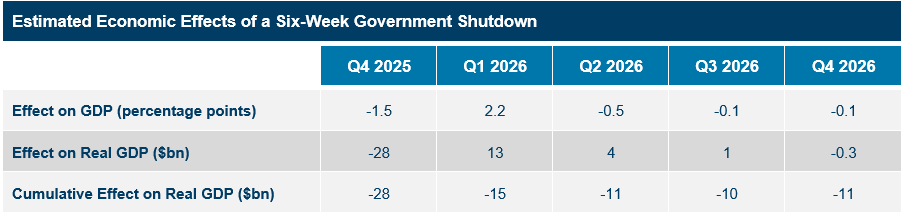
The Congressional Budget Office (CBO) has released its analysis on the economic effects of the government shutdown.  The CBO found that the real gross domestic product (GDP) growth in Q4 2025 would be reduced by 1.5% for the six-week shutdown. However, as the government reopens and federal spending resumes, growth is expected to rebound 2.2% in Q1 2026. After Q1, the boost to growth would fade as output returns toward the level it would have been at in the absence of the shutdown. While much of the lost output should be recovered in Q1, restaurant visits, canceled travel, and deferred services represent permanent losses that cannot be recovered. The CBO estimates a permanent loss of $11bn in economic activity due to the 6-week shutdown, which is small in comparison to the $30 trillion US economy. Overall, the economy is expected to be in a weaker position than had the shutdown not occurred (Table 1). If all furloughed workers are counted as unemployed, we could see a temporary rise in the unemployment rate by 0.4% in October. This is likely to reverse in November once the government reopens.

Table 1: GDP Impact from Government Shutdown

Image
Screenshot 2025-11-18 121433

Source: CBO. A Quantitative Analysis of the Effects of the Government Shutdown on the Economy under Three Scenarios. Oct. 29, 2025. Real values have been adjusted to remove the effects of changes in prices and are shown at a (nonannualized) quarterly rate. The cumulative effect of the shutdown on real GDP is measured as the sum of the quarterly difference between each scenario’s estimate of real GDP and what real GDP would have been in the absence of the shutdown.

Release of Government Economic Statistics
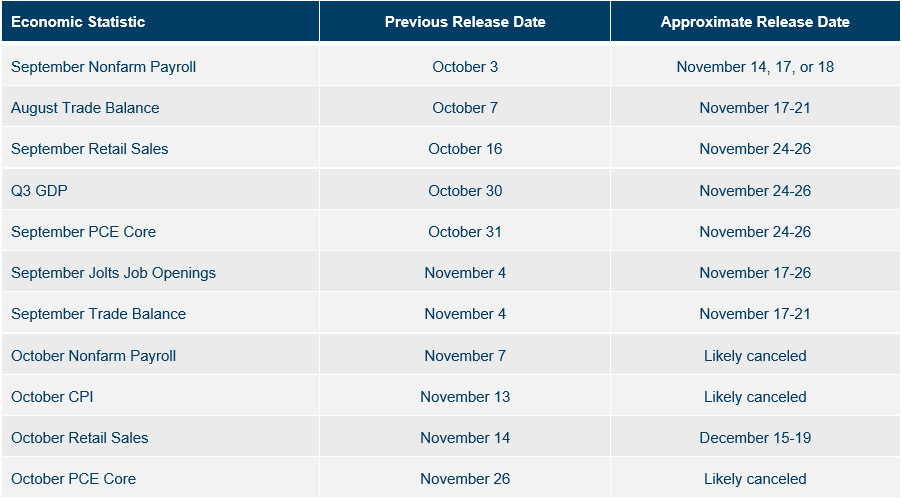
With the imminent opening of the government, we should begin to see economic data releases with a lag. Table 2 provides our best estimate on potential release dates. There are many questions with regards to the timing, collection and accuracy of the data. 

September's nonfarm payroll data will likely be the first release (within 48-72 hours of reopening), as the data collection is already complete and awaiting publication. Initial and continuing claims will be published on their regular Thursday schedule and will be a clean reading since they will match the state-reported data. September retail sales and industrial production is likely to be released a week after the reopening. There are likely to be issues with the October and November data. October data will likely be the most compromised due to the length of the shutdown. It is unlikely we will get the October nonfarm payroll report.

On CPI, it is unclear whether we will see the October and November data due to the length of the shutdown. According to the Bureau of Labor Statistics, it takes a full month to collect all the data but with a strong effort, it can be done in three weeks. However, the Thanksgiving holiday potentially impedes that timeline. Therefore, it would not be inconceivable to have a two-month gap in Consumer Price Index (CPI) data, the first time in the series’ 100-year-old history. If we do see the data, its accuracy could be questioned since it may be dependent on inputted or model-driven data.

Table 2: Likely Release Dates of Economic Reports

Image
Screenshot 2025-11-18 121538

Source: Pioneer Investments as of November 12, 2025. 

Implications for the Fed: December’s Federal Open Market Committee (FOMC)
The next FOMC will be held on December 9-10. At the October 28-29 FOMC, Chairman Jerome Powell discussed how the Fed was driving through fog with the lack of government statistics. However, this time around, the Fed will have more information at their disposal for the December meeting but may still lack full clarity of the state of the US economy (i.e., not enough to completely “drive through the fog”). The Fed is likely to have the September and a truncated October nonfarm payroll report, with September inflation, retail sales and trade data. They may even have the October/November employment reports and Q3 GDP. However, they are unlikely to have the October CPI, Core Personal Consumption Expenditures (PCE), or spending data. Therefore, the Fed will continue to depend on alternative private sector data. We believe a third consecutive rate cut in December is a closer call than current market expectations. Since the September FOMC meeting when the Fed elevated the importance of the labor mandate, there have been signs that the labor market has stabilized and may be rebounding. This could figure into their monetary policy stance, which may be near neutral. In addition, the likely incomplete government economic statistics may be enough justification to push a rate cut decision into early 2026.  

Political Implications of the Shutdown
There has been much confusion over Democratic tactics on the government shutdown following the small group of centrist Democrats ending the impasse with little in return. To Democratic partisans, it looked like Democrats caved to President Trump and the Republicans, especially after Democratic outperformance in local elections on November 4. For Republican partisans, the end of the shutdown highlighted the need to cut spending and end a post-pandemic program. However, the lessons from the November 4 elections showed affordability and peripherally highlighted the importance of health care as a potential key issue for the 2026 midterm elections. According to a KFF analysis, a nonpartisan, nonprofit organization that provides health information, the end to the ACA subsidies will lead to an average subsidized enrollee’s annual premium payment to rise by 114% from $888 in 2025 to $1,904 in 2026. According to a KFF poll taken from October 27–November 2, 74% of voters say Congress should extend the ACA subsidies, including 44% of “Make  
America Great Again” supporters. Given the saliency of this issue, there will be pressure on both sides to pass some form of health care subsidies to cushion the surge in premiums. If they do not, health care will become a tightly fought issue for the 2026 midterm elections.  

Financial Market Implications
Despite the government shutdown, US markets performed well during the record long shutdown. As of November 12, 2025, the US 10-year yield fell 8 basis points to 4.07%, the S&P 500 gained 2.5%, and the US Dollar Index appreciated 1.8% since September 30. Going forward, we may see greater market volatility as investors digest a deluge of government economic statistics and evaluate the current state of the US economy. With the government reopened, we are likely to see an economy growing at its potential growth rate (around 2.0% in 2026) with upside risks due to fiscal stimulus (from the One Big Beautiful Bill Act), the current Fed’s easing cycle, and accommodative financial conditions helping to stimulate economic activity.  


Read more from Pioneer Investments


Important information

Unless otherwise stated, all information contained in this document is from Pioneer Investments, a Victory Capital Investment Franchise. The views expressed regarding market and economic trends are those of the author and not necessarily Pioneer Investments and are subject to change at any time based on market and other conditions, and there can be no assurance that countries, markets or sectors will perform as expected. These views should not be relied upon as investment advice, a security recommendation, or as an indication of trading for any Pioneer Investments product or service. This material does not constitute an offer or solicitation to buy or sell any security, fund units or services. Investment involves risks, including market, political, liquidity and currency risks. Past performance is not indicative of future results. 

The views expressed in this presentation are those of Pioneer Investments, a Victory Capital Investment Franchise, and are subject to change at any time. These views should not be relied upon as investment advice, as securities recommendations, or as an indication of trading intent on behalf of any strategy. Future results may differ significantly than those stated.

©2025 Victory Capital Management Inc.

20251112-4986519

Share this post

Sign Up Now for Full Access to Articles and Podcasts!

Unlock full access to our vast content library by registering as an institutional investor

Register

Contacts


Pioneer Investments

Pioneer Investments manages $128 billion in assets and has a long-standing history of innovation with deep expertise managing fixed income portfolios and creating customized solutions within the more opportunistic areas of the securitized market.

Pioneer Investments’ culture of innovation, in the securitized market, originated at Smith Breeden, where its founders developed early option-adjusted spread modeling techniques for MBS valuation. The innovative approach continues under Victory Capital, which manages over $8.4 billion for insurance companies. We are focused on delivering competitive risk-adjusted returns, while considering the accounting, regulatory, and capital management needs of our insurance clients to create long-term partnerships.  We understand the unique needs of insurers, and we provide customized and efficient risk-based capital solutions that align with insurers' risk tolerances and investment objectives.

Source: Pioneer Investments, a Victory Capital Investment Franchise, as of September 30, 2025
 

Jay Alexander, CFA, CAIA
Managing Director, Institutional Markets
jalexander@vcm.com
+1 (612) 965-5426
 
Emma White
Director, Institutional Markets
ewhite@vcm.com
+1 (617) 422-4569

Marko Komarynsky
Director, Institutional Markets
mkomarynsky@vcm.com
+1 (210) 697-3613

View the contributor page

Sign Up Now for Full Access to Articles and Podcasts!

Unlock full access to our vast content library by registering as an institutional investor .

Create an account

Already have an account ? Sign in

Ѐ Ё Ђ Ѓ Є Ѕ І Ї Ј Љ Њ Ћ Ќ Ѝ Ў Џ А Б В Г Д Е Ж З И Й К Л М Н О П Р С ΄ ΅ Ά · Έ Ή Ί Ό Ύ Ώ ΐ Α Β Γ Δ Ε Ζ Η Θ Ι Κ Λ Μ Ν Ξ Ο Π Ρ Ё Ђ Ѓ Є Ѕ І Ї Ј Љ Њ Ћ Ќ Ў Џ А Б В Г Д Е Ж З И Й К Л М Н О П Р С Т У Ф Х Ц Ч Ш Ā ā Ă ă Ą ą Ć ć Ĉ ĉ Ċ ċ Č č Ď ď Đ đ Ē ē Ĕ ĕ Ė fi fl œ æ ß