

We're currently experiencing email delivery delays. For urgent matters, please contact us directly at lindsay@insuranceaum.com.

Pioneer Investments -

US Government Shutdown – Who Blinks First?

VCMFeatured

Paresh Upadhyaya SVP, Director Fixed Income and Currency Strategies


Executive Summary

  • Shutdown is likely to last longer than the average shutdown of eight days
  • Any economic loss will be recovered once the government reopens
  • Watch two dates that could trigger an end to the shutdown: 10/10 and 10/15
  • If this shutdown unfolds like others, it will be more political than economic
  • Stay long risk assets

The US government shut down on midnight October 1. The shutdown occurred since Republicans and Democrats could not agree to pass a bill funding the government for its fiscal year 2026. Democrats want to see an extension of expiring Affordable Care Act (ACA) tax credits that make health insurance more affordable for millions of Americans and for a reversal of Trump’s cuts to Medicaid, a government healthcare program for the poor. Democrats forced the government to shut down after the Republican majority failed to attain the 60 votes needed in the Senate to pass the spending bill. The House had already passed the bill. This brief note examines the economic and market consequences from the shutdown and looks at scenarios that could end the impasse.

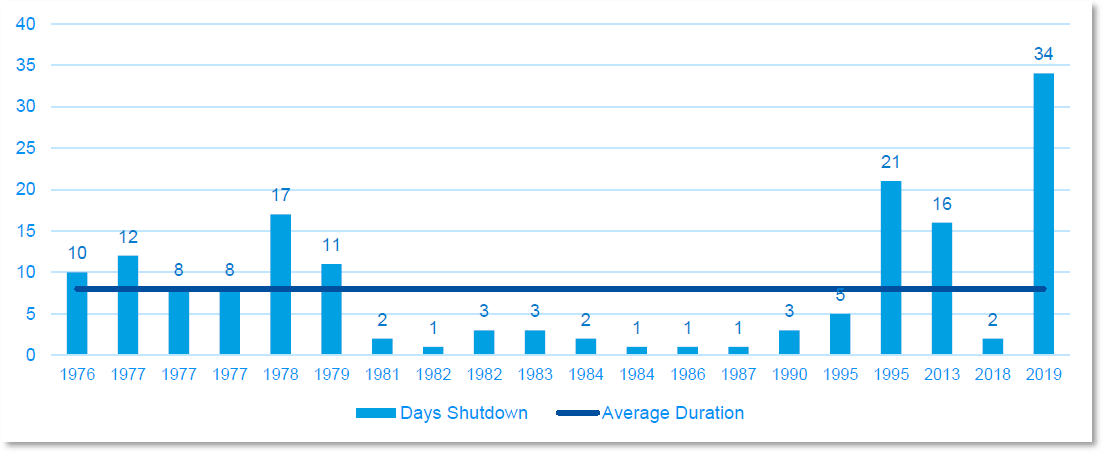
Most shutdowns last eight days. The longest shutdown was 34 days in 2019 (Chart 1). The 2019 shutdown was a partial one since the government was partially funded, which limited furloughs and did not interrupt economic data releases. The 2025 shutdown is more comparable to the 2013 shutdown as there have been no appropriation bills passed.
 

Chart 1: Duration of Government Shutdowns/Funding Gaps
Image
Bar chart showing duration of government shutdowns vs the average of 8

Source: Strategas as of 10/1/25
 

Economic Impact

Economists forecast that the economic cost from the shutdown will amount to between 0.1-0.2% of GDP per week. The reason the impact is rather modest is that only a small part of the government is actually shut down. Mandatory spending, such as Social Security, Medicare, interest payments and defense spending will continue unaffected while discretionary spending will be affected. On the labor side, the Congressional Budget Office (CBO) estimates that 750,000 government workers are likely to be furloughed on a daily basis, that is more than in 2013 or 2018-19. Furloughed workers do not count as a reduction in the establishment survey (nonfarm payrolls) since they will eventually get paid. However, they will be considered unemployed in the household survey. That is likely to push the unemployment rate higher between 0.2-0.3%. Furloughed workers will receive back pay once the government reopens. There could be broader consequences of the shutdown if the Trump administration follows through with its threat of laying off federal workers permanently. Overall, the economic impact is likely to be short lived with most of the economic loss to be recovered once the government reopens.

Market Impact

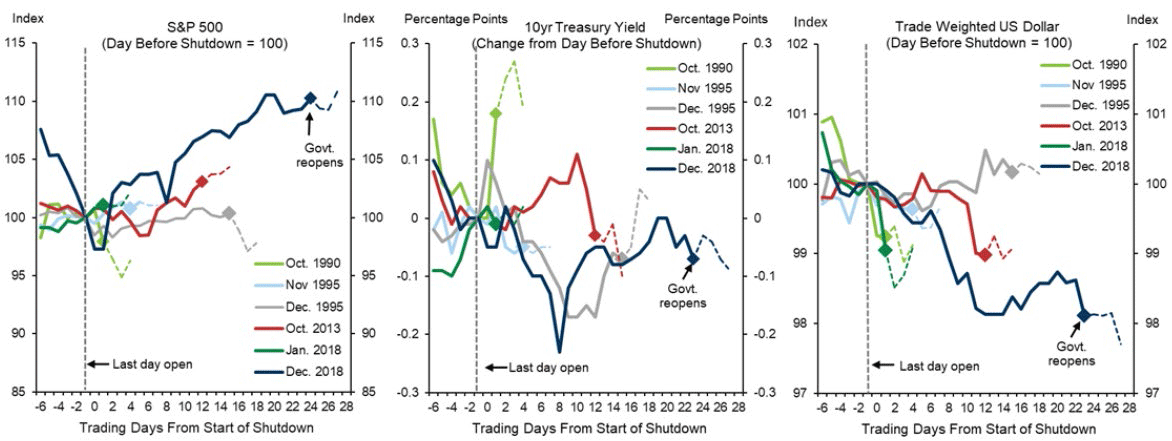
Financial market reactions to previous government shutdowns have been largely positive (Chart 2). Going back to 1990, the S&P 500® Index has mostly rallied. This was especially true in the 2013 and 2019 shutdowns. The 10yr Treasury yield has mostly drifted lower with the exception of the 1990 shutdown. The trade weighted US Dollar has mostly depreciated with the exception of the 1995 shutdown. Given this shutdown is more comparable to the 2013 shutdown, we would expect financial markets to follow a similar return stream.
 

Chart 2: US Asset Market Performance during Shutdown
Image
US asset market performance during shutdowns throughout the years

Source: Goldman Sachs Investment Research as of 9/28/25
 

Data Issues

While the market impact has been rather muted, the lack of data availability will be a bigger question for investors and importantly for the Federal Reserve (Fed). During the shutdown, the government will not be publishing a large array of economic data releases, such as the Consumer Price Index (CPI), employment, retail sales and trade reports. In fact, we’ve already missed the nonfarm payroll release that was scheduled for October 3. Once the government reopens, we will get the September release with a delay. In October 2013, the government reopened on October 18 but the September nonfarm payroll report was not released until October 22, and the CPI was not released until October 30. It is not just the delay of the economic release that is of concern to investors and asset markets but, if the shutdown lasts long enough, it could impact collection and accuracy of the data. In 2013, there was some drop in price quotes for the October CPI data. If the October CPI cannot be sampled, it could affect the November CPI level.

Impact on Federal Open Market Committee (FOMC)

If the shutdown lasts within a couple of weeks, there should be enough time for the FOMC to see the nonfarm payroll report before the October 28-29 meeting. Contrary to popular belief, the Fed is unlikely to receive any data before it is publicly released. It is an open question if they will have the CPI, Producer Price Index (PPI) and retail sales data that was previously scheduled to be released on October 15 and 16. If there is any missing data, I would expect the Fed to lean on alternative data such as ADP and Indeed for the labor market and the prices paid component from the Institute for Supply Management (ISM) services and manufacturing survey for inflation, to mention just a few. 

How Could This End? – Four Scenarios

  1. Democrats Break Ranks – In the last vote before the shutdown, two Democrats and an Independent who caucuses with the Democrats (Sen. John Fetterman-PA, Sen. Angus King-ME, and Sen. Catherine Cortez-Masto-NV) broke rank and voted for the House spending bill. Republicans need seven Democratic Senators. Some of the votes needed could come from Senators in battleground states like Georgia, Michigan, Minnesota and New Hampshire that are up for election in November 2026. These Senators or prospective Democratic candidates could be motivated by adopting a centrist position to improve re-election prospects.
  2. Democrats Back Down – This is likely to be the most conventional outcome. Polls start to turn against Democrats and the pressure builds on them to abandon their demands. In general, the party that triggers the shutdown and trys to extract policy demands is the one that accrues the public’s blame.
  3. Republicans Make Concessions – Republicans compromise or cave to Democratic demands as polls turn against them. White House aides are nervous that the healthcare issue could resonate with voters in the 2026 midterm elections. A Kaiser Family Foundation poll released on October 3 showed 78% of Americans and 57% of Republicans supported extending the ACA subsidies. President Trump or a centrist Republican group of Senators could intervene and come up with a proposal that could end the impasse.
  4. The Shutdown Drags On – Both parties have fairly high unapproval ratings and could both come under pressure to compromise. The 2018-2019 government shutdown ended only after US air travel was on the verge of a massive disruption. That was only a partial shutdown, this time the consequence could be a lot more severe. There are nascent signs of travel delays building.

Key Dates to Monitor

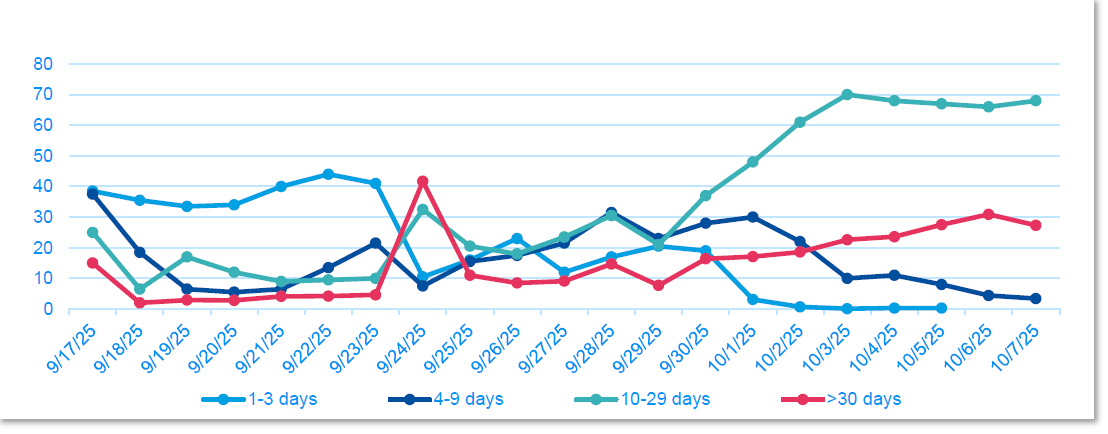
According to Polymarket, the world’s largest prediction market, the probability of a government shutdown lasting between 10 to 29 days is around 70% (Chart 3). The probability of the shutdown at or greater than 30 days is stabilizing around 30%.
 

Chart 3: Polymarket When will the Government Shutdown End?
Image
Graph Polymarket When will the Government Shutdown End?

Source: Polymarket as of 10/7/25
 

With no obvious solution to the government shutdown and neither side showing any appetite to compromise, there are two dates that could help prevent things from spiraling out of control. The first date is October 10, when federal workers are paid, and the second date is October 15, when the military is paid. Neither side wants to be blamed for government workers or the military missing a pay check.

Conclusion

Uncertainty revolves around how the government shutdown impasse is resolved and when. All signs point to a longer-than-usual shutdown. If this shut down follows the lines of most past ones, it will be more a political event than an economic one and investors in the next few weeks are more likely to spend most of their time trying to get clues from companies as they start the Q3 reporting season. Furthermore, history tells us that US financial markets continue to perform during this period of heightened uncertainty. Bottom line remaining long risk assets is the right strategy.


Read More From Pioneer Investments


Important information

Unless otherwise stated, all information contained in this document is from Pioneer Investments, a Victory Capital Investment Franchise. The views expressed regarding market and economic trends are those of the author and not necessarily Pioneer Investments and are subject to change at any time based on market and other conditions, and there can be no assurance that countries, markets or sectors will perform as expected. These views should not be relied upon as investment advice, a security recommendation, or as an indication of trading for any Pioneer Investments product or service. This material does not constitute an offer or solicitation to buy or sell any security, fund units or services. Investment involves risks, including market, political, liquidity and currency risks. Past performance is not indicative of future results.

©2025 Victory Capital Management Inc.
20251008-4886241

Share this post

Sign Up Now for Full Access to Articles and Podcasts!

Unlock full access to our vast content library by registering as an institutional investor

Register

Contacts


Pioneer Investments

Pioneer Investments manages $128 billion in assets and has a long-standing history of innovation with deep expertise managing fixed income portfolios and creating customized solutions within the more opportunistic areas of the securitized market.

Pioneer Investments’ culture of innovation, in the securitized market, originated at Smith Breeden, where its founders developed early option-adjusted spread modeling techniques for MBS valuation. The innovative approach continues under Victory Capital, which manages over $8.4 billion for insurance companies. We are focused on delivering competitive risk-adjusted returns, while considering the accounting, regulatory, and capital management needs of our insurance clients to create long-term partnerships.  We understand the unique needs of insurers, and we provide customized and efficient risk-based capital solutions that align with insurers' risk tolerances and investment objectives.

Source: Pioneer Investments, a Victory Capital Investment Franchise, as of September 30, 2025
 

Jay Alexander, CFA, CAIA
Managing Director, Institutional Markets
jalexander@vcm.com
+1 (612) 965-5426
 
Emma White
Director, Institutional Markets
ewhite@vcm.com
+1 (617) 422-4569

Marko Komarynsky
Director, Institutional Markets
mkomarynsky@vcm.com
+1 (210) 697-3613

View the contributor page

Sign Up Now for Full Access to Articles and Podcasts!

Unlock full access to our vast content library by registering as an institutional investor .

Create an account

Already have an account ? Sign in

Ѐ Ё Ђ Ѓ Є Ѕ І Ї Ј Љ Њ Ћ Ќ Ѝ Ў Џ А Б В Г Д Е Ж З И Й К Л М Н О П Р С ΄ ΅ Ά · Έ Ή Ί Ό Ύ Ώ ΐ Α Β Γ Δ Ε Ζ Η Θ Ι Κ Λ Μ Ν Ξ Ο Π Ρ Ё Ђ Ѓ Є Ѕ І Ї Ј Љ Њ Ћ Ќ Ў Џ А Б В Г Д Е Ж З И Й К Л М Н О П Р С Т У Ф Х Ц Ч Ш Ā ā Ă ă Ą ą Ć ć Ĉ ĉ Ċ ċ Č č Ď ď Đ đ Ē ē Ĕ ĕ Ė fi fl œ æ ß