
Can AI Grow the U.S. Out of Debt?
AI may lift U.S. productivity, but it is unlikely to grow the country out of debt. Here's why high, sustained growth is a long shot.
Read More







AI may lift U.S. productivity, but it is unlikely to grow the country out of debt. Here's why high, sustained growth is a long shot.
Learn More
AI may lift U.S. productivity, but it is unlikely to grow the country out of debt. Here's why high, sustained growth is a long shot.
Read More

Despite ongoing concerns around inflation, tariffs, geopolitical tensions and AI-related disruption, the U.S. labor market remains more resilient than many expected. Our latest Macro Strategy outlook explores several underappreciated trends shaping employment today and what they could mean for growth, inflation and markets going forward.
Read More
The situation in the Middle East deteriorated further than many expected following the June Memorandum of Understanding (MOU). However, the recent escalation should not be mistaken for a complete breakdown in diplomacy. Instead, developments increasingly resemble a low-intensity phase of conflict in which both sides are attempting to re-establish leverage before returning to negotiations.
Read More
Markets have navigated a series of inflationary shocks over the past few years, including Covid, tariffs, and geopolitical tensions, including most recently the closure of the Strait of Hormuz. While disagreements linger between the U.S. and Iran, neither has shown the appetite for full-fledged war.
Read More
Drivers of multifamily performance are evolving. As market outcomes become more differentiated, local fundamentals and market selection are expected to play a larger role in shaping future investment performance.
Read More
Asia’s AI opportunity is expanding beyond chips into power, infrastructure and advanced manufacturing. With structural growth intact but market leadership uneven, disciplined stock selection may be key to finding the next winners in Asian equities.
Read More
MetLife Investment Management examines how investors may need to rethink long-held assumptions about geopolitics, the U.S. dollar and developed market fiscal strength. The article highlights why a more fragmented, multipolar world could require a new investment playbook built around supply shocks, fiscal risk and geopolitical analysis.
Read More
Markets are refocusing on fundamentals as geopolitical noise fades. This Q3 2026 outlook highlights resilient growth, persistent inflation and opportunities in high-quality sectors. Discover where disciplined, income-focused investors can find value.
Read More
Our midyear message is one of constructive realism: pro-risk but not complacent. We favor equities over fixed income, remain selective in credit and believe investors should diversify their diversifiers, as growth tilts north, and bonds become less dependable for equity diversification.
Read More
Private capital is fueling sports growth, offering seniority, diversification and contractual cash flows, while media rights and year-round venue use support resilient income.
Read More
Our credit outlook remains split along a stark AI faultline: technology hardware and utility power providers continue to rally on data center expansion, while enterprise software and tech-enabled business services face structural revenue erosion and margin pressure.
Read More
Core fixed income is regaining its role as a potential portfolio stabilizer. In today’s higher-yield, more volatile environment, it can offer attractive income, diversification and capital preservation, especially when paired with active management focused on consistent, risk-adjusted returns.
Read More
Inflation isn’t just a headline, it’s spreading through the supply chain. Energy costs are lifting producer and import prices, increasing the risk of persistent inflation. Even if energy pressures ease, underlying inflationary momentum is likely to remain.
Read More
Retiree lift outs are reshaping today’s pension plans. Explore what happens after the annuity purchase and how plan sponsors can manage shifting risks through thoughtful modeling, asset choices and ongoing plan oversight.
Read More
U.S. home sales are slowing as higher mortgage rates and softer labor markets weigh on demand. Our latest U.S. Housing Chartbook explores price outlooks and regional impacts for investors.
Read More
MetLife Investment Management’s “Q1 2026 Investment Grade Corporate Market Review and Outlook” highlights a volatile start to the year driven by policy shifts, geopolitical tensions and elevated issuance. Despite increased uncertainty, credit markets remained resilient as higher yields continued to support investor demand.
Read More
Infrastructure debt is gaining attention as a way for investors to potentially access long-term growth while emphasizing capital preservation, resilient income and diversification within private credit portfolios.
Read More
Despite heightened geopolitical risk and inflation concerns, Emerging Markets continue to show resilience. Stronger balance sheets, improving policy frameworks and attractive valuations support EM’s role as a source of potential income and diversification in global portfolios.
Read More
Private credit showed resilience in Q1 2026 with stable spreads, strong issuance and continued demand across private placements, asset-based finance and infrastructure, driven by disciplined structuring and selective risk.
Read More
After years of contraction, U.S. manufacturing is showing early signs of an inflection point. Improved activity, rising production, and stronger investment point to a reset — one led by capital spending, not consumption.
Read More
Geopolitical escalation in the Middle East reshaped markets in Q1. Higher energy prices drove volatility, pushed yields higher and tested credit spreads — creating improved rate opportunities while reinforcing the need for quality and selectivity.
Read More
Equity markets entered the year with renewed momentum, supported by improving economic data and fiscal tailwinds. However, rising geopolitical tensions introduced heightened volatility and reshaped market leadership as the quarter progressed. Explore our full commentary for more insight on the equity markets.
Read More
More than four weeks into the Iran conflict, markets are increasingly focused on how long it may last and what comes next. While the conflict is geographically concentrated, the market impact has been global, driving clear differentiation among emerging market sovereigns based on energy exposure, external buffers, fiscal flexibility and policy credibility. In this environment, fundamentals are once again driving outcomes.
Read More
Our quarterly Relative Value and Tactical Asset Allocation combines insights from our investment teams and the Global Economic and Market Strategy team to assess relative value across major asset classes.
Read More
Industrial rent drivers are evolving as population density, highway access, power availability and automation readiness reshape demand for modern logistics facilities.
Read More
The U.S. housing market continues to face a challenging path forward, and MetLife Investment Management’s Global Economic & Market Strategy team breaks down why in our latest update, “The Long Road to a U.S. Housing Recovery.” We explore how structural supply constraints, persistent affordability pressures, and broader macro uncertainty are shaping the market’s trajectory, despite recent rate cuts.
Read More
The leveraged finance market is currently grappling with an “AI inflection point,” where the early promise of greater efficiency is giving way to a more uncertain outlook, with potential AI-related pressures on revenues and margins.
Read More
The post-strike scenario is thus far playing out largely as might be expected, including Iran’s retaliation, which has hit Gulf Cooperation Council (GCC) countries as it attempts to inflict a cost on the campaign while generating credible deterrence.
Read More
In the early months of 2026, the IG credit market looks much as it did over the prior two years. Yields remain elevated, offering investors compelling carry, while spreads sit near multi-decade tights — levels last visited in the mid-1990s.
Read More
We highlight a resilient and active market environment supported by strong issuance, solid investor demand and stable macroeconomic conditions.
Read More
The U.S. fixed income market remained resilient through late 2025 despite economic uncertainty and data disruptions from the federal shutdown. Our latest commentary highlights the key dynamics shaping investment grade credit markets as we head into 2026.
Read More
Falling global rates, a softer USD and stable commodities lifted performance across EM sectors. Stronger EM fundamentals continued to outpace developed markets. With growth momentum carrying into 2026, disciplined investors may find compelling opportunities ahead.
Read More
Emerging Markets (EM) enter 2026 on the heels of an exceptional 2025 — a year defined by strong total returns and resilient fundamentals despite global volatility.
Read More
After a volatile start in 2025, equity markets recovered as policy risks eased. Improving earnings and shifting investor preferences reignited small cap performance. Supportive valuations and growth tailwinds position small caps for 2026.
Read More
New opportunities could emerge as construction pipelines reset, financial conditions gradually ease, and policy dynamics continue to evolve.
Read More
Economic growth through the third quarter of 2025 came in above expectations and will likely end the year on a strong note. At the same time, the K-shaped economy is more present than ever: even outside the consumer.
Read More
The factors that helped emerging market debt outperform other public bond markets in 2025 – including resilient exports, falling inflation, and accommodative monetary policy – should persist in 2026, and though the magnitude of expected returns may be lower, we believe investors can have confidence in increasing their EM debt exposures.
Read More
With highlights including another quarter-point cut in the federal funds policy rate at the Federal Reserve’s (Fed) mid-month Federal Open Market Committee (FOMC) meeting, a general upward drift in most asset markets and global interest rates tracking higher, December closed out an event-filled year.
Read More
We are optimistic that U.S. markets will likely resume their leadership positions in 2026, particularly as AI investment continues.
Read More
Our more optimistic, if still cautious, view is that credit markets and their infrastructure remain solid and will be buoyed by improving economic conditions in 2026, driven by supportive fiscal and monetary policy, U.S. tax cuts and deregulation, and, critically, ongoing AI expansion — a key area to watch.
Read More
Global equities reached new highs in 2025, driven by the “Magnificent 7” tech giants, yet earnings results more broadly have yielded positive surprises. We see market opportunities extending well beyond tech in 2026, with agility and innovation critical for generating alpha, and active investors should find opportunities to capitalize on market mispricings as earnings growth broadens.
Read More
Investment grade private credit enters 2026 with steady supply and healthy investor demand, creating a constructive yet selective outlook. Elevated rates and shifting sector dynamics underscore the need for disciplined underwriting and a focus on risk-adjusted opportunities.
Read More
Accelerating growth in asset management is a top priority for MetLife in its New Frontier strategy. The acquisition brings together MIM’s institutional strength and scale with PineBridge’s global footprint and deep specialization to position MIM as a top-tier diversified global asset manager.
Read More
MetLife Investment Management (MIM)’s Global Economic & Market Strategy team expects a below-potential growth environment with some consumer cohorts under pressure.
Read More
What are the effects on real estate from K-shaped household income growth, and AI effects on the labor market? Risk for select office and retail segments, although office is still priced too low in select markets/segments. A tailwind for select residential. | How long do multifamily margins compress in the Sun Belt? We expect late 2027.
Read More
MetLife Investment Management’s investment grade corporate credit platform delivered strong results in Q3 2025, supported by resilient investor demand, renewed appetite for duration and the Federal Reserve’s pivot toward rate cuts. Quarterly issuance reached $397 billion — 23% above the four-year average — with September’s $214 billion total marking a record.
Read More
ISM data suggest that inflation pressure may increase in the near future. Recent ADP data showed job gains, but growth was limited to larger firms in specific sectors.
Read More
MetLife Investment Management originated approximately $11.5B across private credit markets in Q3 2025, driven by strong investor demand and disciplined execution across corporate private placements, infrastructure debt and asset-based finance.
Read More
The overarching macro tone is one of cautious optimism. Despite persistent geopolitical tensions, global markets have shown resilience. China’s GDP forecast has been upgraded, and Europe remains stable but vulnerable to fiscal pressures.
Read More
U.S. growth should stay steady, but labor market risks persist. Europe and the U.K. face tariff headwinds, but we expect modest recovery. China’s growth is expected to remain subdued while Japan’s outlook is driven by domestic demand and tech investment.
Read More
Real estate investors and managers frequently rely on qualitative market risk assessments but, in many cases, do not give appropriate consideration to quantitative assessments that are readily available. Put and Call options on REITs provide forward-looking risk indicators that incorporate both historical property sector trends and views on the outlook.
Read More
MetLife Investment Management (MIM)’s Global Economic & Market Strategy team expects turbulence in growth resulting from U.S. policy vacillations to continue to drive expectations for global activity and inflation risks
Read More
Manufacturing jobs have been in decline for the last four months as firms focus on reducing headcount and are not filling open positions.
Read More
Housing supply is tight in the Midwest and Northeast; inventory is building up in the Sun Belt
Read More
MetLife Investment Management originated $3.4B across private credit in Q2 2025, executing 63 transactions across corporate, infrastructure and asset-based finance. Average spreads of ~201 bps over UST exceeded public benchmarks by over 120 bps, reflecting strong investor demand and disciplined execution.
Read More
The Treasury is expected to issue more bills instead of coupon issuance going forward, and that may put more pressure on the Fed in its goal to align its portfolio composition with overall Treasury issuance
Read More
Despite macro headwinds — elevated tariffs, geopolitical tensions and weaker economic data — credit spreads tightened during Q2, with excess returns bouncing back after April’s sell-off. Strong technicals, persistent demand for yield and moderate supply drove the rally, particularly in intermediate maturities.
Read More
We expect global economic risks from U.S. policy changes to remain high, as we expect little domestic resistance to the U.S. administration’s ever-shifting policies.
Read More
Emerging Markets (EM) may be uniquely positioned to help portfolios with income and return potential within a world of many changes. One supportive tailwind for Emerging Markets Debt (EMD) is the fading of U.S. exceptionalism.
Read More
We anticipate slower growth and sticky inflation
Read More
Chicago commercial real estate has underperformed over the last decade. The gross unlevered return across all property types averaged 3.8% versus a 5.8% U.S. average, and the underperformance continued during the 3Q 2022 – 3Q 2024 commercial real estate (CRE) downturn.
Read More

Plan sponsors face a unique set of challenges that require a more dynamic approach to asset allocation. In this Q&A, the experts at MetLife Investment Management (MIM) explore how the interest rate environment and market volatility are prompting sponsors to pursue de-risking strategies by increasing and diversifying fixed-income allocations.
Read More
We were a year into the CRE recovery when April 2’s broad-based tariffs landed; policy-driven volatility likely to continue this summer and beyond.
Read More
The ongoing trade war has added volatility to financial markets.
Read More
MetLife Investment Management originated over $3.75B across investment grade private credit markets in Q1 2025, driven by strong investor demand and disciplined execution across corporate, infrastructure, and structured debt.
Read More
Q1 returns in the taxable municipal market were strong—but not for the reasons you might expect. While falling Treasury yields boosted performance, policy-related risks and technical pressures raised questions about where valuations go from here.
Read More
Emerging markets have entered 2025 navigating a new phase of geopolitical and economic volatility. With the Trump administration’s trade-first agenda introducing fresh uncertainty—and a Fed now facing the prospect of stagflation—EMD investors are weighing both disruption and opportunity.
Read More
During periods of external shock like the Global Financial Crisis (2008) or COVID-19 (2020), the macro variables that impact EM sovereigns can change suddenly and dramatically, necessitating a rethink of our credit views.
Read More
This month we investigate the details of the labor market for signs of weakness.
Read More
Infrastructure debt provides investors with access to a defensive asset class with lower correlation to economic cycles than general corporate debt given the essential nature of infrastructure assets.
Read More
Our quarterly update examines the market turbulence of Q1 and how short duration strategies navigated the challenges—and opportunities—of heightened macro uncertainty.
Read More
We believe the Post-World War II, U.S.-dominated world order of globalization is quickly coming to an end. Between the possibilities of diversification, division, and disengagement that we discussed in our piece on globalization several years ago, the Trump Administration appears to be pursuing a disengagement strategy. Everyone – domestic players in the U.S. included – is now working to accommodate a less globally engaged U.S.
Read More
The cold storage real estate segment continues to “institutionalize,” and we expect this trend will help push capitalization rates down, and values up, in the sector.
Read More
Our current “Investment Grade Private Credit Review & Outlook” recaps 2024 in the corporate private placement, global infrastructure debt and private structured credit markets. We highlight origination and activity in each IG market and look ahead to 2025. Find out:
Read More
Market Strategy anticipates slower growth and desynchronized central bank policies.
Read More
As the Federal Reserve’s (Fed) balance sheet normalizes, an important step will be to structure the System Open Market Account (SOMA) portfolio to more closely match the composition of outstanding Treasury debt.
Read More
We believe that even though 2025 is off to a rough start, firms and consumers will continue to adapt, and growth will stabilize over the year. Many of the negative impacts of lower activity in the beginning of the year (weaker consumer spending, weaker consumer confidence and high imports to front-run tariffs) are idiosyncratic and have the potential to be offset in subsequent quarters, resulting in overall growth that is healthy, albeit weaker than 2024.
Read More
Our “Q4 Investment Grade Corporate Market Review & Outlook” examines how Treasury yields and corporate spreads reacted to a busy quarter of market-moving events, highlighted by President Trump’s election. We chart portfolio attribution for Q4 and 2024, then look ahead to catalysts that could push credit spreads wider in 2025.
Read More
President Trump made several changes to trade policy in his first term, and U.S. firms have adjusted accordingly. Trade exposure has shifted away from China, and investment abroad has shifted toward Europe and the Western Hemisphere.
Read More
Between 2017 and 2022, 11 Emerging Markets (EM) sovereigns defaulted, representing approximately 15% of the Emerging Markets Bond Index (EMBI) weight taken 12 months prior to default. These defaults can be categorized into three distinct groups based on the catalysts that drove each country into default: pre-COVID self-induced, COVID-induced, and war-induced.
Read More
Private debt markets in emerging economies may offer unique opportunities. They can help insurance-industry investors to seek yield enhancement, diversification and less-correlated returns compared to traditional public debt.
Read More
Our latest Short Duration Quarterly Commentary recaps Q4 2024 and shares our sector outlook for short duration bonds. With the Trump administration shifting policy expectations for 2025 and a cautious Federal Reserve.
Read More
Our current Emerging Markets Review and Outlook recaps Q4 in emerging market debt and looks ahead to 2025, with the Federal Reserve’s path forward unclear and markets bracing for the uncertainty of Trump administration policy changes.
Read More
The U.S. consumer remains strong on the back of a healthy labor market, and inflation is moving back to target, albeit slowly.
Read More
Scope 3 emissions are becoming increasingly important as issuers face growing pressure to report and reduce these emissions. In our latest report, we examine how issuers across public fixed-income and private credit sectors are tackling Scope 3 data challenges and setting decarbonization targets.
Read More
By the end of this month, President Trump will enter the White House for his second term with an economic backdrop quite different from that of his first term. While the policies he advocates for are of a similar style this time around, the entirely different economic situation mean that those policies may have a different effect than they would have had in his first term.
Read More
The post-COVID years have been characterized by dramatic shifts in economic conditions, capital markets and the geopolitical landscape. No two years have been quite the same, and uncertainty in the outlook for the economy in general, and commercial real estate in particular, has been historically elevated.
Read More
Our latest Relative Value and Tactical Asset Allocation report offers our take on key markets and sectors. While we anticipate a low risk of a U.S. recession, policy uncertainty opens up a wider range of possible outcomes.
Read More
Physical climate risk incorporates two broad hazard categorizations: acute and chronic. Climate risk software and analysis tools typically forecast each hazard individually and across multiple timeframes and scenarios.
Read More
As the dust from the U.S. election settles, the new year brings new challenges. Tariffs are likely to be the dominant theme early in 2025. Our base case is for the incoming Trump administration to impose substantial — albeit not universal — tariffs on most countries.
Read More
Governments, businesses and consumers all took advantage of a decade of free money. Bond markets are now multiple times larger than before the Great Financial Crisis (GFC), having soared to record levels. Economic activity and most financial markets benefited. As central banks around the world swiftly raised interest rates to fight inflation, significant challenges are emerging, especially concerning the ability to refinance or repay substantial volumes of maturing debt.
Read More
Our macro strategists assess what rightsizing the Fed’s balance sheet in 2025 could mean for its holdings in mortgage-backed securities, Treasury notes and Treasury bills. The composition will significantly impact different asset classes, the shape of the yield curve, and the amount of new stimulus created each month.
Read More
Our new paper, "Residential Whole Loans: Key Insights for Insurance Investors," highlights the strategic advantages of this asset class, including improved underwriting standards and attractive risk-adjusted returns.
Read More
Until recently, Central and Eastern Europe (CEE) sovereigns were not on the radar for most Emerging Markets investors searching for yield. Learn why MetLife Investment Management sees an opportunity to gain exposure to the region and its respective sovereign curves in our analysis of Central and Eastern Europe.
Read More
Our latest chartbook offers a compelling overview and outlook for the current U.S. real estate market, including statistics on real estate pricing, apartment construction starts and appraisal lag.
Read More
As part of MetLife Investment Management’s ongoing “A World in Debt” series, we continue to explore key trends across various sectors of the financial markets. In "Investment-Grade Spreads: Tighter for Longer?”, we navigate the 'overheating' stage of the credit cycle, this paper provides an in-depth analysis of the economic indicators influencing tight spreads, lessons from past overheating periods and projections for the future of credit markets.
Read More
We believe our security selection driven approach will provide enough ammunition to generate relative outperformance – just as it has throughout 2024
Read More
A resounding victory sweeps President (and President-Elect) Trump back to the White House. The substantial-for-modern-times majority in the Senate along with the popular vote means that the second Trump administration has more of a mandate than the first one.
Read More
MetLife Investment Management’s Private Capital Group manages $135.5 billion in assets as of September 30, 2024. With over 100 years of investing in the asset class, MIM offers exceptional access to investment grade deals with global scale, longstanding market relationships and approachable expertise. Our standing in the markets for infrastructure, corporate private placement and private structured credit often enables us to fund an entire deal or become its cornerstone, which can lead to larger allocations for our clients. Informing our investment decisions is a team-based risk culture with a time-tested approach to managing risk, combined with proprietary research and layered independent oversight. More than 70 seasoned industry specialists collaborate to develop customized portfolio solutions that help meet our clients’ needs.
Read More
The markets showed considerable resilience during the third quarter (Q3), with assets in Emerging Markets (EM) responding favorably to the U.S. Federal Reserve’s (Fed) initial rate cut of the cycle. The Fed maintained a consistently dovish tone throughout the quarter, and the softening data supported the 50-basis point (bps) rate reduction at the September meeting. The 2/10s yield curve finally entered positive territory for the first time in over two years, as further rate cuts seem likely. The 10-year Treasury yield experienced an 84-bps peak-to-trough movement within the quarter, ultimately finishing 62 bps lower at 3.78%.
Read More
With high volatility, geopolitical dynamics, the Presidential election and Federal Reserve’s course of action keeping the market on the fence, MetLife Investment Management recaps the third quarter for short duration bonds and shares our year-end outlook, sector by sector.
Read More
Rain makes grain, and in 2024, crop growers in the U.S. received plenty of it. When agricultural commodities become too abundant, prices decline alongside sector profitability. Although drought conditions pose considerable challenges, they also create notable opportunities for U.S. crop producers, making it a potentially more favorable environment to operate in.
Read More
In 2025, we believe the core question to dominate economic discussions is where the unobservable natural rate, r*, lies and when central banks should stop cutting. Find out what else our Macro Strategists think will drive marks in 2025. Read our latest Economic Monthly:
Read More
We are anticipating a stable macro environment in the near future, with some uncertainties stemming from U.S. elections and monetary policy. We continue to look for spreads to mostly remain range bound, with a low chance of further tightening. With a low risk of recession, a carry strategy is preferred in the next quarter or two, meaning we prefer investments with attractive yields, while remaining cautious about potential weakness.
Read More
For over 15 years, public pensions have relied on long duration investment grade bonds like US Treasuries and corporates to achieve their risk reduction goals. MetLife Investment Management’s new white paper examines the chief benefits: capital preservation, reliable cash flow and liquidity, capital efficiency, excess value returns and more. Learn all about the diverse opportunity set in our in-depth analysis, Long Duration Bonds in Public Pensions.
Read More
Read our latest Economic Monthly to find out how we think Fed Funds cuts could play out and why - despite some headwinds - there are a number of factors supporting consumer resilience.
Read More
This chartbook presents a compelling snapshot of the current state of the U.S. real estate market, highlighting signs of emerging stability and solid underlying fundamentals. It reveals that certain segments, with appealing valuations and consistent demand, are exhibiting potential for substantial growth.
Read More
Emerging Markets (EM) ended the second quarter (Q2) with minimal movement from a total return perspective in the hard currency space, while the dollar continued to strengthen versus its peers. Risk appetite remained largely supportive with volatility remaining suppressed, with high yielding hard currency assets the significant outperformer year-to-date (YTD). US data was mixed with April’s strength being offset by some late quarter weakness. US rates peaked at 4.7% early in the quarter only to end at 4.4%, 20 basis points higher quarter-over-quarter.
Read More
The markets had their fun in the first week of August, responding to the Sahm Rule being triggered alongside perceived excess hawkishness by the FOMC. Download our latest Economic Monthly to find out why we think generalized anxieties are driving the market overreaction.
Read More
We expect US Treasury issuance to continue to exceed $2 trillion annually in coming years, four times the pre-pandemic average – even as global demand flattens. In the first of our ongoing series, “A World in Debt,” our Macro Strategy team examines why we expect these changes to lead to higher yields and volatility. What are other implications of rising supply and shifting demand?
Read More
The latest Economic Monthly from the MIM Macro team drills down into the ongoing strength of the US consumer sector.
Read More
We believe the influence of governance on Uruguay’s credit profile and risk premium has been positive. The country has a long history of strong institutions and consensus-based policy-making tradition that leads to durable policy decisions and supports social cohesion.s.
Read More
MetLife Investment Management’s Alex Strickler, Head of Securities Lending, explains how our differentiated “mismatched book” approach can yield incremental income for borrowers comfortable with a measured level of interest rate and credit risk.
Read More
“A clear destination without a roadmap” captures the many complexities – and opportunities – of the megatrend transition to a largely electric road transport future. In this new far-ranging analysis, MetLife Investment Management’s Fixed Income team examine key challenges and uncertainties facing the auto industry’s legacy OEMs, new players and policymakers.
Read More
Global energy transition to a low carbon future will require a record $8 trillion investment annually from 2024 to 2050. 70% of that transition finance is projected to come from the private sector.
Read More
MetLife Investment Management continues to see consumers willing and able to spend for the next several months. While credit card delinquencies have risen dramatically, other loan types appear healthy. Weaker GDP is more than offset by stronger private domestic final purchases (PDFP).
Read More
Auto loan securitizations accounted for over 57% of $256 billion in new ABS volume in 2023. Despite rising interest rates and regulatory changes encouraging banks and credit unions to monetize their prime auto loan portfolios, investment opportunities persist for client portfolios. We map out the analysis in Shifting Gears: The Acceleration of Prime Auto Securitization.
Read More
Commercial mortgages are at the intersection of evolving capital market conditions, shifting real estate fundamentals and complex regulatory landscapes. Today’s investment conditions in the commercial mortgage sector are unique, both historically and compared to other institutional asset classes.
Read More
Global manufacturing activities continued appear stable (see Figure 2), thanks to expansions in output, new orders, and employment. U.S.—We are expecting no recession in the United States in 2024 but look for growth to slow to 2% and inflation to remain near 3%. We are looking for a period of renewed economic volatility driven by a variety of domestic and global factors.
Read More
Developed-market economies are still hanging together. In our December forecast, we were too pessimistic about growth overall and too optimistic about the decline in inflation in the U.S. and the U.K. Our short-term rates forecasts remain mostly unchanged, with the major exception being the U.S., where we were too optimistic about the U.S. Federal Reserve’s (Fed) ability to cut rates. U.S. debt sustainability concerns faded but could reassert themselves at the end of the year when the debt ceiling debate will begin anew.
Read More
The U.S. Federal Reserve has reduced the pace of quantitative tightening with a new monthly roll off cap of $25 billion of Treasury securities, down from $60 billion (Source: U.S. Federal Reserve, May 2024).
Read More
Stickier than expected inflation and robust economic activity have delayed and diminished expectations for rate cuts in 2024. Markets are now pricing only 25 basis points of cuts for later in the year, down from the 150-200 bps in cuts that were priced in at the end of 2023. While economic data have been stronger than expected, persistent restrictive monetary policy could negatively impact the broader economy and remains a downside risk.
Read More
Private Structured Credit (PSC) presents a specific investment avenue, seeking to offer insurance investors yield pick-up vs public bonds, capital efficiency, risk mitigation via covenant protection, and sector diversification.
Read More
We now expect the U.S. economy to avoid a recession in 2024. Businesses are emerging as a backstop – largely due to high and rising profit margins, a manufacturing rebound and a resilient services sector. However, we do remain somewhat concerned about the strength of the consumer. Find out why in our latest Economic Monthly.
Read More
Major economies are looking for their GDP to run below long-term trend (see Figure 2), with China continuing to slow gradually despite economic re-opening and policy stimulus.
Read More
Approximately 25% of the companies in the 2022 S&P Global Corporate Sustainability Assessment (CSA), set net-zero targets. The buildings sector, both operational and new construction, is responsible for 39% of global emissions.
Read More
The economy in any single year is subject to the vagaries of chance and, as such, can be “noisy”. Near-term volatility that exerts short-term stress into markets may be front of mind for most investors, but it is long-term trends that provide us with the best view of the future, especially for those with long investment horizons.
Read More
New paper making the case for U.S. productivity. Drawing on many difference data sources that highlight why the U.S. economy is on the verge of a productivity boom.
Read More
President Trump could win the 2024 presidential election. When the incumbent presidential party presides over an improvement in the unemployment rate, it is likely to be returned to power. With unemployment at historic lows, unemployment is likely to get worse, creating headwinds for a Biden re-election.
Read More
Guy Haselmann, Head of Thought Leadership at MetLife Investment Management (MIM), recently sat down with Ruth Farrugia, Global Head of Insurance Asset Management at MIM, to discuss strategic asset management for Insurance Companies.
Read More
What should be considered gateway markets and core property types today? The investing universe and real estate markets have evolved dramatically over the last few decades. See the list of markets that now rank highly as gateways and which once-niche sectors could be labeled core property types under our proposed definitions.
Read More
Looking at the data of the first six weeks of the year, we have seen some promising economic indicators, with consumer health shored up by a robust job market. But we believe the U.S. economy is not out of the woods yet. Find out why in our latest Economic Monthly.
Read More
We believe 2024 will be a year of lifting fog for commercial real estate. While that will be a welcome development from the obscurity of 2023, fog can lift to reveal the challenges on the road ahead. This is especially true when considering the potentially new-normal pricing regime. Still, we think the clarity offered by the coming year will be a step in the right direction of healing real estate capital markets. We expect transaction activity to begin recovering during the year, as buyers and sellers agree on the outlook for interest rates and thus real estate values. Although many macroeconomic factors remain unresolved, we believe that the resilience of the U.S. consumer will enable the U.S. economy and real estate sector to successfully overcome the challenges of the year ahead. Download and read our full outlook today.
Read More
After a strange — and surprisingly strong — 2023, we expect a paring back of global growth in 2024. For the U.S., we expect recession, while for Japan and China, we expect positive but decelerating growth. We expect European countries to avoid a recession in the first half of the year with improvement in the second half. We expect inflation to normalize toward central bank targets over the year.
Read More
Our latest article which discusses a range of scenarios for the U.S. fiscal outlook. We examine the underlying causes which make fiscal adjustment so complicated and consider the probability of further downgrades and outlook revisions.
Read More
The unemployment rate has been creeping up gradually since July, reaching 3.9% this past October according to the BLS. By some measures it is approaching a threshold traditionally considered indicative of a recession. Is the Labor Market on the precipice?
Read More
Getting the House in Order. Take a look into our latest Economic Monthly as we highlight how we think the latest developments in Washington could play out. We also explore the state of the U.S. labor market, debt to GDP, 10 year treasury yields and inflation expectations.
Read More
MetLife Investment Management’s latest real estate outlook highlights some early signs of opportunities for well-capitalized investors, as the fog begins to lift from the backdrop of a challenging economic outlook and disruptive real estate capital market conditions.
Read More
The paper highlights the expectations of key global economic drivers broken down by region and asset class, from MIM’s Global Economic & Market Strategy Team. It calls out the asset classes that they believe are over-valued or under-valued compared to the underlying fundamentals. This edition shares commentary on global growth, treasury yields, credit market valuations, US housing and US equities.
Read More
The U.S. political situation is back into economic focus as a government shutdown looms, with funding set to expire on September 30 if no short-term funding agreements are passed. We do not expect a shutdown to change the trajectory of Federal Reserve policy. The 10-year Treasury may decline slightly in the short-run as it generally has after a shutdown, but equity markets have historically had a mixed response.
Read More
With yields rising to the highest level in decades, Will Pattison, Head of Real Estate Research & Strategy discusses inflations impact and opportunities he sees in Real Estate debt and commercial mortgages.
Read More
Over the last 25 years, the EM investable universe has grown in breadth and depth to become one of the most intricate in the entire fixed income space. Its intricacy originates from a wide range of risk factors across geography, quality, and duration that can offer interesting alpha opportunities to investors when understood and properly differentiated.
Read More
In our latest real estate insight, Jim Landau and Giuls Kunkel explore the layers of interconnection between a greener grid and renewable resources, and how the strengths, weaknesses, opportunities and threats associated with greening the grid may influence asset managers’ decarbonization strategies.
Read More
The Insurance Insights paper provided Relative Value & Tactical Asset Allocation insights for Insurance Clients and prospects and includes views on Global and U.S. Economies; Asset fundamentals, valuations, and technicals; multi-asset portfolio strategy, etc.
Read More
In our midyear review of global risk, we assess current risks relative to our full-year 2023 outlook in January, including sticky inflation in the U.S. and Europe, and uncertainty related to the U.S.-China relationship.
Read More
Guy Haselmann recently sat down with Jingsu Pu to dig through the proposed changes S&P Global is considering to its Insurer Risk-Based Capital Adequacy Methodology. Jingsu will help assess what it could mean for insurers and their ratings.
Read More
Guy Haselmann recently sat down with Jingsu Pu to better understand the issues and complexities around Interest Maintenance Reserve (IMR). IMR was the most talked about topic at a recent conference attended by Jingsu.
Read More
In our latest Real Estate market outlook, we detail how various cities and property types are positioned amid economic uncertainty and capital markets volatility and outline a framework for considering where real estate prices are in a market with low liquidity.
Read More
Guy Haselmann, Head of Thought Leadership at MetLife Investment Management (MIM), recently sat down with William Pattison, Head of Real Estate Research at MIM to discuss real estate investing. Will helps break down the various sectors into understandable categories and mentions some of the challenges and new opportunities of each.
Read More
Taming inflation is the main theme for global economies. Tightening monetary policy, slower growth and rising recession risk are all likely having an impact.
Read More
Since the twin crises of the pandemic and the Russian invasion of Ukraine, many have become worried about the future of globalization. In this article, we sketch out a few plausible paths forward, including disengagement, division and diversification, and conclude with our thoughts on markers to watch.
Read More
Guy Haselmann, Head of Thought Leadership at MetLife Investment Management, recently sat down with Scott Pavlak, Head of Short Duration Fixed Income, to discuss interest rates and the investment landscape in short duration bonds.
Read More
Discussion on global opportunities in the rapidly growing - but under resourced - area of water infrastructure. The discussion covers areas such as clean waters journey, treatment plants, wastewater, storage, droughts and floods, and the technology that makes it all work.
Read More
The Insurance Insights paper provided Relative Value & Tactical Asset Allocation insights for Insurance Clients and prospects and includes views on Global and U.S. Economies; Asset fundamentals, valuations, and technicals; multi-asset portfolio strategy, etc.
Read More
The Federal Reserve continues to focus on inflation when setting policy. Despite this, the recent Summary of Economic Projections shows the Fed cutting rates even as inflation remains above 2%. In this report we ask the following three questions: · What is so great about a 2% inflation target anyway? · Is it likely that the Fed would maintain a tight policy even when unemployment begins to rise? · How might we determine when a policy pivot is under consideration?
Read More
EM portfolio team provides a comprehensive look at the many factors that have been impacting Emerging Market Debt. The paper looks at current valuations and offers a roadmap for capitalizing on the opportunities expected to unfold in 2023.
Read More
We expect a global recession with decelerating inflation in 2023. The report discusses upside and downside risks to our baseline, including the Fed’s inability to tame inflation, the Russia-Ukraine conflict’s effect on commodity and food prices, and slower than expected economic growth in China.
Read More
The reports explain how Buy Now, Pay Later loans could be a window into financial stress on certain groups of consumers.
Read More
As we went through all the charts in this report, a clear theme seems like that all markets were pricing in peaking inflation and Fed pivoting in last couple of weeks. G4 interest rates retraced sharply after a relentless rally. Dollar seems to have formed a peak. Commodity index looks like peaked as well, which usually leads a peak of inflation. DM equity market sentiment also turned positive. However, given that the long-term downtrend is intact, the current short-term upturn remains viewed as bear market rally in our view. EM equity looks relatively attractive.
Read More
In the latest episode of “MIM Cuts to the Chase”, Tani Fukui examines the various economic cross-currents and provides a rationale for where she thinks the economy and Fed policy is headed in 2023.
Read More
Economic forecasts are particularly uncertain right now, and an honest assessment requires considering multiple scenarios. We still expect a recession but see a soft landing as the most likely, off-base case scenario.
Read More
In the latest podcast of “MIM Cuts to the Chase”, Jim Grace discusses why analyzing climate related variables should play a part of bottom-up research to determine appropriate credit spread levels and how they can lead to identifying alpha generating opportunities.
Read More
Core real estate equity exposures offer a multitude of benefits to diversified multi asset class portfolios. Rising inflation and risk-based capital (RBC) changes that took effect 12/31/21 are fueling broader interest by insurance companies in commercial real estate equity. This report outlines the rationale and the primary factors to consider.
Read More
At the June 9, 2022 meeting of its Valuation of Securities Task Force (“VOSTF”) the National Association of Insurance Commissioners (“NAIC”) discussed a staff recommendation to change how the risk-based capital (“RBC”) for insurers’ investments in collateralized loan obligations (“CLO”) is determined.
Read More
Over the past several decades, the residential rental sector has grown from relative obscurity to become one of the largest and most important institutional investment asset classes. The sector offers a wide range of investment options, including a range of risk profiles (mortgages, stabilized assets, transitional assets, ground up development), housing formats (high-rises, garden apartments, manufactured housing, among others), and geographic options. In recent years, investors have also begun segmenting investment options by the income profiles of residents, and new targeted strategies have emerged. One such strategy that we believe offers attractive risk adjusted returns and supports the need for more affordable housing is Moderate Income Rental Housing.
Read More
Macro paper on trends in China including policy shifts, demographics, economy trends, stimulus policy all leading toward the 20th Party Congress.
Read More
We believe private U.S. commercial mortgages can fit well in a multi-asset portfolio due to their historically favorable risk-adjusted returns versus other asset classes, as well as their attractive income return potential and lower historical loss rates versus public corporate bonds with similar risk profiles. Given these attributes and at times opaque nature of the U.S. commercial mortgage market, we believe selecting investment management platforms with experience, resources, and scale are able to better source and manage commercial mortgage investments.
Read More
The key economic and market themes remain downbeat. We continue to prefer up-in-quality credits and underweight risky assets. Global economic growth could continue to slow over the next several months. U.S. 10-year yield and inflation are likely to have peaked, which could result in a fully inverted yield curve. A short, sharp recession is likely in the mid-to-late next year. The credit cycle is aging fast, given tightening lending standards, slowing profit growth, and margin pressures.
Read More
Our 3rd paper in MIM’s Carbon Neutral series focuses on government legislation and regulation, as well as incentives that may stimulate the production of renewable energy.
Read More
The paper explains why the MIM Macro Strategy team expects Fed Funds rate cuts in 2023, despite markets lowering their rate cuts expectations. Moreover, they believe the higher they hike over the next few quarters, the more likely they will have to cut in 2023.
Read More
Household income exceeded spending by a total of $5.5 trillion during the pandemic, or 72% above what it might have been in normal times.
Read More
What will the next recession look like? Each past recession has had its own characteristics: borrowing from Tolstoy, every recession makes us unhappy in its own way. We, of course, don’t know exactly how the next recession will make us unhappy, but we can take some hints both from history and from the current state of the economy.
Read More
Commercial mortgage loans (CMLs) have become an important component of private investment portfolios over the past 30 years. Interest in commercial mortgages began growing as the sector was institutionalizing in the 1990s1 and continued to grow in more recent years as mortgages found utility within an expanding array of investment structures. Private commercial mortgage-debt funds, for instance, have shown 11% average annual fundraising increases over the past 10 years.
Read More
Guy Haselmann, Head of Thought Leadership at MetLife Investment Management (MIM), recently sat down with William Pattison, Head of Real Estate Research to discuss the impact that the high inflation and rising interest rates is having on Commercial Real Estate
Read More
In the second quarter, credit spreads in the front end of the maturity spectrum continued to move wider and interest rates moved higher as the market responded to liftoff and the promise of more rate hikes to come.
Read More
MetLife Investment Management’s global strategists look toward the second half of 2022 with concerns about recession, inflation, China and the possible effects of the Russia-Ukraine war on energy prices.
Read More
For our latest discussion, Syed Ahmed, Director of Infrastructure and Project Finance and Guy Haselmann, Head of Thought Leadership sit down for a conversation on the scope, scale, opportunities and challenges in the rapidly growing area of digital infrastructure.
Read More
This paper provides an argument for why 2022 may be the ideal timing for long short credit exposure and highlights several of the potential benefits for investors of all types. Furthermore, the paper highlights MetLife Investment Management’s long short credit strategy.
Read More
Metlife Investment Management views primary risks to the 2022 global economic outlook to include inflation, slowing Chinese and U.S. growth, Central Bank policy mistakes, geopolitics, and energy prices.
Read More
MetLife Investment Management’s (MIM) real estate research team provides updated views on relative value in the commercial real estate space, including updated property price forecasts, and considerations for investors who believe inflation may not be transitory.
Read More
This article transcribes a roundtable discussion of sustainable private credit. The Q&A format paper discusses topics that include deal sourcing across geographies, the role and significance that sustainable investing plays in MIM’s origination, and the inputs used to qualify sustainable metrics.
Read More
We believe the Fed’s balance sheet normalization carries underappreciated risks as the assumption of a benign balance sheet runoff is dependent on a single historical example in 2017-2019. We expect elevated market volatility as the balance-sheet normalization process takes place.
Read More
The current global market environment is unique, with investors searching for yield and questioning the funding dynamics of governments and corporates around the world. We believe fundamentals and valuations within Emerging Markets (EM) remain attractive relative to Developed Markets. For insurance companies, investing in EM debt can increase portfolio diversification and generate attractive capital-adjusted yields, and there are various strategies and structures available for insurance investors.
Read More



The single-family rental sector is following the same path toward institutional acceptance that apartments navigated in the 1990s and 2000s. Demographics and cultural changes along with technological advances in software, property management, and data have led to vast improvements in performance and transparency
Read More
It has been over five years since the Paris agreement has been signed and private sector carbon neutrality pledges are on the rise. We take a look at what the real estate industry doing and ask if it is enough.
Read More
Scott Moses, portfolio manager of emerging market debt (EMD) at MetLife Investment Management sat down with Pensions Age to discuss the latest trends within EMD and the opportunities these can provide for pension fund investors. They discuss how the pandemic affected investments, what regions to be excited about and more.
Read More
We describe four major economic frictions that converge in climate change, scrambling the signals between prices and optimal production.
Read More
The high September headline CPI print of 5.4% concealed moderate price increases for the month, but going forward housing inflation is the indicator to watch.
Read More
In recent business cycles, rates have peaked relatively soon after recession end. Most forecasters are expecting a gradual peaking of rates in 2023 or later; we expect rates to peak in 2022.
Read More
Rising inflation, an improving economy, and Risk Based Capital changes taking effect 12/31/21 are fueling broader interest by insurance companies in commercial real estate equity. This report outlines the rationale and the primary factors to consider.
Read More
U.S. real estate investors are benefitting from economic growth coupled with “made-for-CRE” monetary policy. Out of favor property types including retail, office, and hotel may offer attractive relative value today, and should not be ignored by investors seeking a diversified portfolio.
Read More
Every credit cycle leaves a lasting mark on corporate behavior, management financial policy and capital allocation. Today companies that have been able to build ample cash are faced with capital allocation decisions, which could further impact the trajectory of leverage. Learn more about how investment grade corporates fared through the cycle, recent trends, including ratings migration especially in the long credit market and how we are navigating the current environment
Read More
The NAIC approved updates to risk-based capital (RBC) bond and real estate equity factors for U.S. life insurance companies; we examine the changes from the prior RBC regime, as well as the implications on relative value considerations and life insurers’ strategic and tactical asset allocation.
Read More
Rate volatility and several idiosyncratic stories during the second quarter drove market performance within Emerging Markets. With delays to vaccine rollouts and continued high daily new cases and deaths hindering re-opening plans and putting excess pressure on economies, EM countries have lagged in the COVID-19 recovery. We expect Emerging Markets recovery to be a second half 2021 story, with countries starting to take active steps to reduce some of the unprecedented policy actions. We remain optimistically cautious given still robust accommodation, supportive growth and positive flow dynamics. In this paper, we look back at Emerging Markets in the second quarter, as well our expectations for the asset class in the second half of the year.
Read More
The first chart in this report, U.S. 30 Yr. Yield, reminds us that the long-term downtrend is well and strong. There are some early signs that the short-term downtrends for G4 government bond yields may change. U.S. HY Spread widened a bit in last couple of weeks, but we feel that the risk of a spread spike remains low. U.S. equity continues its rally, and EM equity seems like already peaked. Commodities remain solid, while US Dollar and Gold are in trading ranges.
Read More
The insurance industry is expecting significant changes in investments risk-based capital, and for structured product portfolios these changes could amount to a paradigm shift.
Read More
In this paper, we examine the varied commitments the real estate investment industry has made to determine if our industry is contributing to the goal of carbon neutrality in a meaningful and more importantly, measurable, way.
Read More
On May 27th, 2021, NAIC’s Life RBC Working Group approved an ACLI-sponsored proposal to reduce risk-based capital (RBC) factors for real estate equity (REE). MetLife Investment Management hosted an interactive moderated panel discussion to discuss these changes and the investment implications for life insurance companies.
Read More
he Great Recovery of 2021 has so far been volatile and difficult to navigate. The remainder of the year could be at least as difficult with the added stress of potential Central Bank actions, which themselves are highly dependent on ever-changing data signals. We examine the greatest risks to our 2021 forecast.
Read More
The G4 government bond yields have been grinding lower from their recent peaks for last few weeks. The immediate downtrend may continue. US 2s10s yield curve spread seems to be more predictable than the 10yr yield level. Continued equity rally and tightening HY spread suggest that market sentiment remains bullish. US Dollar is stabilizing. Commodity rallies are intact, while they are approaching key resistances.
Read More
With the economy expanding rapidly, growth in GDP is bringing the customary inflationary pressures along with expectations of rising interest rates. Given the supportive economic backdrop, we see value in floating bank loans. We will explore different segments of the bank loan market and highlight potential benefits and risks of the asset class.
Read More
Although the COVID crisis caused significant economic disruption and has been defined as a recession, actions to stabilize the economy eliminated many of the positive effects that recessions can have including the failure of non-productive businesses. As a result, it is unlikely we are in a new business cycle. Rather, it is more likely we are returning to the business cycle of early 2020, albeit with significant changes to consumer and monetary and fiscal authority balance sheets.
Read More
MetLife Investment Management will host an interactive moderated panel discussion to discuss these changes and the investment implications for life insurance companies.
Read More
In our most recent commercial real estate outlook, we outline why cap rates may fall during the second half of 2021, explore recent work-from-home and office leasing trends, and comment on the unique “K” shaped nature of the economic downturn/recovery.
Read More

The Taxable Municipal market rallied aggressively in the first quarter. In our 1Q21 market review and outlook, we discuss what triggered this and explore market conditions and events that are likely to influence the asset class going forward.
Read More
Today, the hotel sector continues to face challenges, but we believe the most difficult period for hotel demand is behind us. In the very short-term, we believe investors who can provide liquidity to the hotel market can potentially achieve attractive returns.
Read More
In our latest report, we recap market impacts to short and intermediate duration fixed income assets for Q1 2021 and how that impacted our strategy as well as performance.
Read More
In our first quarter Emerging Markets review and outlook, we review current market conditions and global events as they relate to this asset class.
Read More
Overall, the first quarter of 2021 has exhibited stark changes in the landscape for fixed income investors. We believe from a fundamental perspective, pandemic depressed earnings and record issuance has left investment corporate balance sheets over-levered for their ratings with debt ratios more than a full turn higher than pre-pandemic highs. And while we feel technicals remain supportive of investment grade corporate spreads, valuations remain less compelling. Learn more in our latest investment grade corporate outlook.
Read More
Fundamental economic data continues to support the continued risk-on market sentiment. Learn more in our latest technical analysis chart pack.
Read More
A risk parity strategy is an asset allocation strategy that can be used for both strategic and tactical asset allocation. In our most recent study, we explore the feasibility, effectiveness, implementation variables and limitations of this strategy when applied to a fixed-income-only portfolio, which may be more interesting to insurance asset and pension fund managers.
Read More
In most fixed-income markets we are back to where we started in 2020 with low rates, tight spreads and warnings from some that asset prices across sectors may be overheated. What are fixed-income investors to do? For MIM’s Private Structured Credit strategy, it’s back to the basics – trying to identify higher-yield, investment grade opportunities that don’t fit neatly into the traditional asset-backed securities market or private securities market and work with borrowers to find financing solutions for these non-conforming sectors.
Read More
This emerging market debt discussion considers the challenges many EM sovereigns will face following the unprecedented year of 2020, and features input from MIM’s global team, many of whom share their perspective on themes that we believe will be most relevant to emerging markets bond index investors in a post pandemic world.
Read More
Supply chains have become a much-maligned component of the international trade system. We examine the N95 mask shortage during the COVID-19 pandemic and argue that it demonstrates the difficulties of unraveling supply chains.
Read More
We expect the U.S. economy to grow – and grow rapidly – in 2021. But we expect the ride to be quite rocky, and the forecast to be more uncertain than usual.
Read More
John Tanyeri, Head of Infrastructure and Project Finance, and Stuart Ashton, Director, Leasing and Tax Equity Investments, were recently featured by Infrastructure Investor in the article Buying into the Energy Future.
Read More
Although analysts missed the pandemic, it should be noted that a pandemic forecast would not have been unreasonable. Natural disasters occur with some regularity including, but not limited to, volcanic eruptions, solar flares and earthquakes. History suggests we may have one of these disasters or a pandemic roughly every nine years. What we cannot know is how much damage they will cause when they happen.
Read More
Blockchain, a revolutionary way of transmitting information trustlessly through time, has captured the imaginations of software developers, economists, and now, central bank policymakers worldwide. Blockchain is a version of distributed ledger technology, a system whose fundamental structure dates back hundreds of years to the Micronesian island of Yap.1
Read More
In MIM's fourth quarter investment update, they highlight their private placement debt origination activity for 2020 and their outlook on market conditions for 2021.
Read More
There is a lot of discussion and worry about inflation in 2021. MIM believes there is a long way to go until they get to the Fed’s 2% average inflation target. Learn more.
Read More
The speed of vaccine rollout and its effectiveness to end this pandemic are the key to determine both the direction of the real economy and the next move of the markets. Learn more in this month’s technical analysis chart pack.
Read More
After a chaotic and difficult 2020, MIM look forward to finally turning the page to a new year. MIM believe 2021 will be a year of a multispeed recovery. For each region, MIM presents their base case forecast for key economic indicators and highlight key regional risks to keep an eye on.
Read More
Interest in socially responsible investing continues to gain ground as climate change and social issues have become increasingly prioritized by stakeholders. MIM believes a larger focus on passive management, significant interest from institutional investors, and increasing regulatory scrutiny on both corporations and investment managers will continue to shape capital allocation processes.
Read More
Interest in socially responsible investing continues to gain ground as climate change and social issues have become increasingly prioritized by stakeholders. MIM believes a larger focus on passive management, significant interest from institutional investors, and increasing regulatory scrutiny on both corporations and investment managers will continue to shape capital allocation processes.
Read More
High yield corporate bonds and bank loans are core asset classes within many insurers’ strategic asset allocation frameworks. While insurers’ exposure to high yield declined in recent years as a result of de-risking actions taken late in the credit cycle, this trend likely has reversed in H1 2020 mainly due to the large magnitude of ratings downgrades; namely fallen angels. Given the complexity of managing insurance company investment portfolios and the inherent higher risk nature of high yield, there are many factors for insurers to consider when assessing the optimal exposure, pursuing portfolio sales and evaluating new investments in the asset class.
Read More
There is no doubt that environmental, social and governance (ESG) principles play an increasingly influential role in investment management today. For real estate investors in particular, climate change has arrived as a material risk both in terms of physical risk from floods, hurricanes, and wildfires, as well as transitional risk such as compliance, insurance, and tax increases.
Read More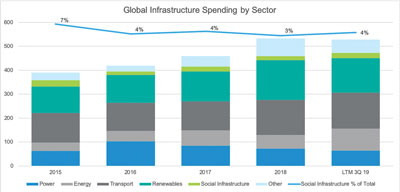
The need for investment in U.S. transportation and energy has received a great deal of publicity in recent years. However, the attention on the country’s aging social infrastructure has been less prevalent.
Read More
Patrick Manseau, CFA, of MetLife Investment Management joins the InsuranceAUM.com Podcast to discuss infrastructure debt, digital infrastructure, and underwriting discipline in today’s market.
Read More
Kerry O’Brien and Harold Myers of MetLife Investment Management discuss how insurers integrate tactical asset allocation within long-term strategic frameworks while maintaining discipline, governance, and capital efficiency.
Read More
David Politano, Head of Debt Strategies at MetLife Investment Management, shares how insurers approach CRE lending differently from banks and CMBS, offering insights into market trends, risk, and long-term value.
Read More
Frank Melaccio of Horizon Blue Cross Blue Shield of New Jersey and Jason Young of MetLife Investment Management discuss investment-grade private credit and asset-based finance in health insurance portfolios.
Read More
Join host Stewart Foley on the InsuranceAUM.com Podcast for a deep dive into private structured credit (private ABF) and its role in insurance portfolios.
Read More
Join host Stewart Foley on the InsuranceAUM.com Podcast for insights into private real estate debt. Explore market trends, commercial mortgage yields, and the impact of inflation and migration on real estate investment strategies for insurance portfolios.
Read More
Alfred Chang is the Head of Residential Credit at MetLife Investment Management.
Read More

Tom Smith is a Emerging Market Portfolio Manager at MetLife Investment Management.
Read More
Exploring the NAIC’s proposed changes to CLO capital charges and what they mean for insurance investors.
Read More
In this episode of the InsuranceAUM Podcast, host Stewart Foley explores the convergence of real estate equity and ESG in insurers’ portfolios. From RBC changes to inflation hedging and sustainability strategies, discover how real estate offers opportunities for long-term performance and positive impact.
Read More

Join host Stewart Foley on the InsuranceAUM.com Podcast as we explore the challenges and opportunities shaping insurance investment strategies in today’s evolving economic landscape.
Read More
Join host Stewart Foley on the InsuranceAUM.com Podcast as he explores emerging market debt, income opportunities, and risk considerations for insurance investors.
Read More1 All data as of June 30, 2026. At estimated fair value. For further information, see MetLife’s 2Q26 Total AUM Fact Sheet, which may be accessed through MetLife’s Investor Relations web page at https://investor.metlife.com.
2 All data as of June 30, 2026. At estimated fair value. For further information, see MetLife’s 2Q26 Total AUM Fact Sheet, which may be accessed through MetLife’s Investor Relations web page at https://investor.metlife.com. AUM count includes (i) each managed account for a third-party insurance company with a unique investment strategy and (ii) each investment by a third-party insurance company in a MIM- sponsored fund.